Showing posts with label review. Show all posts

Sunday, December 14, 2025

The newest Frankenstein: a review.

Sorry that I forgot to put up the usual and customary "on vacation" graphic for last week. But I assume y'all figured out that I was gone.

This week, I want to talk briefly about a movie I watched last night -- the newest remake of Mary Shelley's Gothic horror novel, Frankenstein; or, a Modern Prometheus

Movie poster image stolen from Wikipedia
I'm not a huge fan of horror films these days -- too many of the new ones are slasher flicks -- but I have liked Guillermo del Toro's work in the past. I thought Pan's Labyrinth was very cool, and I liked The Shape of Water well enough to buy it (high praise for me!). So I knew I needed to watch his version of the Frankenstein story eventually, but I'd been putting it off. My favorite Frankenstein movie is Mel Brooks' Young Frankenstein, after all, and I knew this wasn't going to be anything like that. 

(We pause now to recite some of my favorite dialogue from Young Frankenstein

  • "What hump?" 
  • "Ovaltine?" "NOTHING! THANK YOU!"
  • "Blucher!" neiggggghhhhh!
That's enough for now. Thank you for your indulgence.)

It has been lost on generations of students required to read the original novel that the Creature isn't the real monster in Shelley's story -- it's Victor Frankenstein, the Creature's creator. Del Toro gets it. And unlike many film directors of the past, he gives the Creature's version of the tale as much weight as he gives Victor's. Victor tells his side of the story to the Danish captain whose ship, stuck fast in ice in the frozen North, rescues him from the Creature's latest attack. But then the Creature -- who has suffered multiple attempts to end his life, discovering in the process that he cannot die -- climbs aboard the ship and tells the captain, and Victor, what happened to him after surviving the fire that Victor set to destroy him.

The Creature had holed up in an abandoned mill attached to a home, and through chinks in the walls, he watches the family who lives there care for each other. He develops an attachment to the blind grandfather, and poses as a traveler to spend the winter with the old man after the rest of the family departs for warmer quarters. This is not far afield from Shelley's story. The blind man cannot see the Creature, so he bases his interactions with him on his gentle nature and naivete. He teaches the Creature to read. He also teaches him the Christian tenet of forgiveness. But when the family returns, they try to kill the Creature, setting him on a path to find his father in the hope that Victor will make him a companion.

But after the fire, Victor renounced his life's work, and he is in no way interested in making another creature. So the Creature, enraged, chases him into the frozen North to kill him.

Unlike in Shelley's novel, however, del Toro's Creature has learned about Christian forgiveness. And Victor has realized he was wrong about his creation; he's not an it, but a human being. Victor apologizes to the Creature -- to his son. And the Creature in turn forgives Victor.

It's not all sweetness and light from there -- the ending is still tragic, as befits a horror movie -- but it's a lot more hopeful than Shelley's ending. In the book*, Victor is consumed by hatred of his creation, and that hatred kills him. There's no apology; by the time the Creature catches up to him, Victor is dead. The Creature creates a funeral pyre for his maker and then leaves to kill himself.

I'm not enamored of Shelley's Victorian morality, but I'm not sold on del Toro's relationships-turning-on-a-dime ending, either. The movie is two-and-a-half hours long, and I get that del Toro needed to wrap things up pretty fast. But a little foreshadowing of Victor's change of heart toward his son would have gone a long way for me.

So my favorite ending for the story is still the one in Young Frankenstein, in which Frederick, Victor's grandson, and the Monster swap brains. Frederick ends up with the Monster's giant "schwanstucker", delighting Inga, while the Monster gets Frederick's sophistication and his intended, Elizabeth, who fell for him in this immortal scene: 


Madeline Kahn was gone far too soon.

***

*Don't @ me about spoilers from Shelley's book. It was published in 1818.

***

I probably should mention the acting in del Toro's movie. Oscar Isaac is a force of nature as Victor; I loved him in Marvel's Moon Knight, too. And Jacob Elordi turns in a wondrous performance as the Creature.

***

We are not going to talk about the fact that Young Frankenstein is 51 years old.

***

These moments of monstrous blogginess have been brought to you, as a public service, by Lynne Cantwell. Stay safe!

Sunday, May 18, 2025

Andor and its relevance to today.

Let's talk about Andor, which wrapped up its two-season arc this week. 

Public Domain, according to Wikipedia. Don't @ me.

The series is a prequel to the 2016 movie Rogue One, which itself is a prequel to Star Wars Episodes IV, V, and VI. Anakin has already become Darth Vader, Luke and Leia are teenagers, and the Empire is charge of the galaxy -- for now. But the imperial government is committing atrocities in Emperor Palpatine's name, and people on multiple planets are beginning to rebel. Cassian Andor gets swept up in the nascent Rebel Alliance; his backstory is what the show is all about.

If you're not a Star Wars fan, I've already lost you, so I won't go into many more details. What I want to focus on is the reaction to the show and how it maybe dovetails with what's going on in our world right now.

I've heard several people say that Andor is the best entry in the Star Wars universe, or at least the best since the original film trilogy. I personally think Andor is very good, if not the best; the writing and direction are smart, and the actors all do good work. It's hard for me to call this show the absolute best of them all because I haven't seen all of them and because the shows are all doing different things. I very much liked Obi-Wan Kenobi for sentimental reasons; I loved The Mandalorian, but it feels like a Western with starships instead of horses (and let's be honest, Boba Fett was season 1.5 of Mando). 

I think what sets Andor apart is that it's meant to be an adult show from the get-go. The whizbang technology is all stuff we've seen before. There's no Grogu to lighten the mood. There's hardly any mention of the Force until the very end of the second season. It's all just people put in untenable situations and how they react to their lives being torn apart by brutality.

Which leads me to today. It's possible that this is the best possible time for this show to appear. Here in the US, we are in the beginning stages of an authoritarian takeover of our government. We are hearing about more instances of brutality every day. The modern-day resistance is taking its time to gel -- pushing back around the edges and seemingly not making much of a dent. A large-scale uprising like the Rebel Alliance may have to happen before we can beat back our modern-day Palpatine and his minions.

***

I had only seen Rogue One once before Andor started airing. Once the show was over, I went back and watched the movie again. And yeah, the show is much better than the movie. Disney was hoping that Rogue One would be the same kind of hit as the original Star Wars movies -- but Jyn's character is lacking both the gravitas to pull off a serious film and the pals that made A New Hope so much fun. This time around, I found myself waiting impatiently for Captain Andor to show up so we could get on with things.

I'm not sure whether I'll ever watch Andor again, but twice is definitely enough Rogue One for me.

***

One quick thing related to last week's post about the new pope: I need to say something about this YouTube video that made the rounds right after the announcement. As soon as the first guy said, "ope," I was like, "My dudes, he's not that kind of Midwesterner. You are thinking too far north." Chicagoland is not the land of Fargo, A Prairie Home Companion, hotdish, and yah-you-bet. Not even the accent is the same. If you want to hear the difference, listen first to the folks in the movie Fargo -- here's the trailer -- and then to Illinois Governor J.B. Pritzker. If you can't tell the difference, I don't know what to tell you. Except maybe "Aw, jeez."

***

These moments of bigger-than-life blogginess have been brought to you, as a public service, by Lynne Cantwell. Yah, you bet!

Sunday, January 5, 2025

"Wicked" defies gravity.


Stolen from https://www.brit.co/wicked-movie/
I realize I'm about a million years late to the party -- the movie version of Wicked has been out in theaters since Thanksgiving weekend -- but my bottom line still holds: If you haven't seen it already, you should.

It's still playing in theaters, but I chose to pony up $20 to see it on my TV at home. It was definitely worth the cost. 

The story, in one form or another, has been with me for most of my life. When I was a kid, I watched the original movie, The Wizard of Oz, every year when it ran on TV. I also read L. Frank Baum's novel that started everything off (plus a couple of the sequels). Pretty sure I saw The Wiz at some point, too.

Then Gregory Maguire's version of the Wicked Witch's story was published in 1995, and turned the whole thing on its head. One of my daughters read the novel first, then loaned it to me. After decades of rooting for Dorothy, reading the ending of that book seriously messed with my head.

We saw a touring production of Wicked the musical at the Kennedy Center in 2011. So of course I wanted to watch the screen version to see if it matched up. It did not disappoint. Cynthia Erivo is terrific as Elphaba, and Ariana Grande is perfect as Galinda/Glinda. Michelle Yeoh seems to be everywhere these days (Star Trek: Section 31 starts in just a couple of weeks), and she is as wonderful as always as Madame Morrible, both before and after her true nature is revealed. Jeff Goldblum is sorta typecast as the Wizard. Jonathan Bailey does a great job as Fiyero, the bad boy who turns the heads of both Glinda and Elphaba. (I couldn't remember where I'd seen him before; it turns out he plays Anthony on Bridgerton.) 

It will come as no surprise to anyone that the movie has whizbang special effects -- much more so, of course, than the stage version, where Elphaba just flying, live on stage, was impressive. 

Speaking of the casting, there have been some complaints among certain factions, particularly in regard to Erivo as Elphaba -- because Erivo is Black, and there has been no effort to make her appear less so. I think it's important to note that "woke" casting goes way back for this show; the original scriptwriters were Jewish, and Idina Menzel, who is also Jewish, originated the role of Elphaba on Broadway. Elphaba's whole thing is not just her magical ability, but that she's green. She's clearly used to getting a lot of flak for her skin color, and it seems like it would be a no-brainer to cast someone in the role who has lived experience as an "other" throughout her life. Plus Erivo does a great job in the role. So, y'know, whatever.

Grande has also been the target of criticism for being cast as Glinda, but she's not just a pop singer -- she got her start on Broadway.

I'm a bit bummed that the movie only covers the first part of Elphaba's story, although it shouldn't have been unexpected; it seems like Hollywood has lost the ability to wrap up a story in under two hours.  But I get that "Defying Gravity" was written to send the theater audience to intermission on a high, and it would be asking a lot of a movie audience to just pivot to the next scene without some time to catch a breath.

I'll be interested to see how they handle the second half of the story. The material is a lot darker than in the first half; the ending should be absolutely wrenching. I can't help but think of a comment I overheard from someone leaving the movie version of Into the Woods: "They should have stopped it at intermission," or words to that effect. Guaranteed there will be viewers of Wicked: For Good who will feel the same way. Here's hoping they take time to read the book between now and November, so they have some sense of whether to see it at all.

***

I may be taking some time off from blogging here shortly. I'm heading into the busy season at work -- the state legislature starts a 60-day session January 21, and we're gearing up for it now. On top of that, I've signed myself up for two online classes. One is a five-session class on the Celtic god Cernunnos offered by John Beckett and Jason Mankey, which starts the week after next. The other one is a seven-week course in beginning Irish that starts next Sunday. Yeah, I'm gonna try learning that blasted language again. I won a contest for a free course from Let's Learn Irish, and I could hardly turn it down. 

Anyway, the point being that it's gonna be a busy winter here at La Casa Cantwell. Something may have to give. If blogging ends up being that something, I'll try to let you know in advance.

I may go mad by mid February. But I might come out the other side with some ideas for another book. Weirder things have happened.

***

These moments of musical blogginess have been brought to you, as a public service, by Lynne Cantwell. Stay safe!

Sunday, January 21, 2024

The state of American fiction.

I had a day off from work yesterday (not always a given during session), so I saw a movie, and you get a blog post about it.

By http://www.impawards.com/2023/american_fiction_ver2_xxlg.html, Fair use, https://en.wikipedia.org/w/index.php?curid=75101757
(Sorry about the gnarly cutline. I don't want anybody coming after me for copyright infringement.)

American Fiction has already won numerous awards, and supposedly there's Oscar talk for Jeffrey Wright, who plays Thelonious "Monk" Ellison. Monk is a literature professor at a West Coast college who is forced to take a leave of absence after a student complains about him writing the N word on the board (it's in the title of a Flannery O'Connor short story). That incident is the tip of the iceberg; Monk is tightly wound due to his agent's inability to sell his latest novel (a retelling of Aeschylus). Despite his literary cred, his novels keep getting categorized as "African-American Studies" because he's Black. And his attendance at a literary festival in his hometown of Boston only makes it worse when he sees that the biggest draw is a novel by a Black woman -- a graduate of Oberlin -- whose novel relies heavily on stereotypical Black narrative elements and street slang.

Monk's visit to his family home is one of the film's revelations. He comes from an upper-middle-class -- maybe even upper-class -- background. His sister is a lawyer; his brother is a plastic surgeon. The family home is a lovely old house in a lovely old-money neighborhood. The family owns a beach house. His mother employs a woman who's clearly been with the family since the kids were small. Everything is so far from the streets that it's no wonder that Monk is frustrated about the state of publishing for Black writers. But then his mother's health begins to degenerate. There's talk of having to sell the beach house to cover her care. And Monk decides to give the White publishing establishment what it wants: a novel full of Black stereotypes that he calls My Pafology. He writes it as a joke, and he insists that his agent send it out.

Of course, it's snapped up immediately for a huge advance. Monk needs the money, but he doesn't want it -- not on those terms. So he tells the publisher that he wants to change the title to Fuck. He figures that will kill the deal. But of course it doesn't. And Monk -- the upper-middle-class college professor -- is forced to do marketing for the book using a persona that his agent came up with on the spur of the moment: a Black criminal who did time for a felony and is now on the lam.

The movie is being marketed as a comedy, and there are definitely funny moments. But there's a lot more to American Fiction than that. There's family drama, and there's Monk's character development. There are sweet moments, too. 

And there's the critique of the publishing industry that drew me to the movie in the first place. The film's thesis is that publishers pigeonhole serious writers of color as "African-American Studies" while glorifying the "raw", "visceral" and "real" street life of poor Black people that Monk has made up. Undoubtedly there are people living that life. But Monk insists that there's more to being Black in America than that, and he maintains it's a failing of White folks that we ignore it in favor of sensational stories about drunks on crack in the 'hood who shoot each other as a way of life.

As an aside, I enjoyed actually seeing Wright, who I knew only from his voice role as The Watcher in Marvel's What If... shorts on Disney+. There's also a very funny appearance by Michael Cyril Creighton, who's also in the cast of Only Murders in the Building. And Leslie Uggams plays Monk's mother.

I wouldn't call American Fiction a perfect film, but it's very good, and it has some important things to say about the state of publishing, not just for Black authors but in general. I hope it's not consigned to the same fate as Monk's serious novels: critically acclaimed but lost in the shuffle. I enjoyed it. Go see it.

***

It wasn't lost on me that I'm a White woman who saw the movie as part of an audience of White people. Maybe we'll learn something from it?

***

These moments of bloggy movie reviewing have been brought to you, as a public service, by Lynne Cantwell. Stay safe!

Sunday, October 29, 2023

The Ushers' modern-day fall.


Stolen from the internet
I've been a big fan of Edgar Allan Poe's writing since I was a little kid. I thought I'd told this story here before, but I couldn't find it just now in a search, so here goes: When I was in elementary school, a collection of Poe's short stories was among the paperbacks my mom bought me. I loved a whole bunch of those stories, but "The Masque of the Red Death" was my favorite. I actually read it aloud one day to a bunch of my friends from the neighborhood in our backyard. (They were all younger than me. I had to kind of explain the part about how there was nobody in the costume.)

So when I heard that Netflix was doing "The Fall of the House of Usher", I was psyched. And I'm here to tell you that this show is definitely worth watching.

This production is not a modern-day retelling of the short story; it's more of an homage to all of Poe's work. There is a "house of Usher", but it's not a mansion -- it's the crumbling two-story house with a basement where Roderick and Madeline Usher grew up. In this version, the siblings are twins; their single mother was impregnated by her boss, an utter asshole who lives in a real mansion down the street and who never claims the kids as his own. Dad owns a company called Fortunato Pharmaceuticals. Eventually -- the turn of events is laid out in detail in the series -- their sperm donor dies and they gain control of the company. Then they proceed to manufacture an opiod painkiller that supposedly isn't addictive -- except, of course, it is, and lots of patients die. When the company -- and the Ushers -- are finally put on trial for their part in those deaths, they also start dying, and Roderick's six offspring are the first to go. Each one dies in a different way -- all gruesome, all with a reference to one of Poe's stories, and all orchestrated by a mysterious woman named Verna. We don't find out who she is until the last of the eight episodes, and even then, her exact identity is shrouded in mystery. Suffice it to say that the Usher twins sold their souls to some kind of demon to gain their success, and the bill has now come due.

Apparently the director, Mike Flanagan, is well known for turning out creepy stuff. I'm not much of a fan of modern-day horror, either movies or TV shows (I realize that's a weird admission, coming from someone who has written horror in her time), and so I don't think I've seen anything else he's done. But I may have to check out some of his other work now, because I really liked this series. It's a little gorier than I prefer, but none of the gore seemed gratuitous. It all made sense, given the plot.

Judging by a couple of reviews I've read of this series, I guess Flanagan uses a stable of actors in his work. I only recognized two in this show: Mary McDonnell, from the Battlestar Galactica reboot, and Mark Hamill. And I can't say I actually recognized Hamill. His portrayal of Arthur Gordon Pym, Esq. -- aka the Pym Reaper, the Usher family's lawyer -- was astonishing. If I hadn't known, going in, that it was him, I wouldn't have known who it was. That's how far from Luke Skywalker this character is.

Anyway, regardless of whether you're a fan of Poe, if you like creepy stuff, I highly recommend that you check out The Fall of the House of Usher on Netflix. And if you are a fan of Poe, have fun noting all the names and situations that have been borrowed from Poe's work. Either way, you won't be disappointed.

***

These moments of creepy blogginess have been brought to you, as a public service, by Lynne Cantwell. Stay safe! Blessed Samhain and happy Halloween!

Sunday, November 27, 2022

What women want.

Not long ago, I got around to watching Three Thousand Years of Longing. (I admit it: I skipped the in-person theater experience and waited 'til the streaming price had dropped below ten bucks.) I had really looked forward to this film. It seemed promising: the stars are Tilda Swinton and Idris Elba, and it included some Arabian Nights-like tales. 

And at first blush, the film delivered: it had humor and tenderness and love, and if not a totally happily-ever-after ending, then at least an as-happily-as-things-could-end ending. I came away from it oddly satisfied.

But as the glow faded, I started thinking about what I'd seen. And I came to the conclusion that I'd been had. 

First, though, the premise: Swinton plays Alithea Binnie, a narratologist -- a scholar of storytelling. She is in Istanbul for a conference of like-minded scholars when she runs across a decorative bottle in a junk shop. Impulsively, she buys it. The next morning, as she's cleaning who knows how many eons of grime off the bottle, the top pops off and out swirls a djinn, played by Idris Elba. The djinn tells her he's been trapped in that bottle for a couple of centuries. Then he pesters her into making three wishes, as djinni do -- and they must be for her heart's desire. "I know what women want," he says at one point, or words to that effect. There must be something her heart desires.

She shrugs. Her heart desires nothing. She is happy with her life in London and with her career. She had a love affair once that didn't work out, and now she is happy to be single. The only thing she wants is to know how the djinn got stuck in that bottle.

Thereby hangs the majority of the movie. The djinn recounts his adventures -- or rather, misadventures -- with several women, starting with the queen of Sheba and ending, always, with him trapped in a container of some sort for the next several hundred years. 

His tales have an extraordinary effect on Alithea. She decides what she wants, more than anything, is to be loved the way this djinn had loved the queen of Sheba. And because his nature requires him to grant wishes, he does.

As Alithea observes, though, in any story involving the granting of wishes, there's always a catch. In this story, the transition for the djinn to the modern world nearly kills him -- so of course he and Alithea can't be together forever. They work out a sort of truce -- that's the as-happily-as-things-could-end ending I mentioned earlier.

I don't think I'm spoiling much by telling you all this. The published reviews I've seen cover the same points -- and as most of those reviewers have said, the best parts of the movie are the stories the djinn tells. Once he has granted Alithea's wish, he stops telling stories, and the rest of the movie kind of flits by.

But as I've said, I liked it when I saw it. I liked that things didn't work out perfectly for Alithea and the djinn; that's how love affairs typically go, even when they don't involve a magical creature. My problems began later, after I thought about what I'd seen.

My main issue was that the djinn never explained what he meant when he said he knew what women want. And after ruminating on it, I realized that what he may have meant is this: No matter what a woman says -- no matter how happy she claims to be -- her heart's desire is to be loved and cherished by a mate.

And here I thought the heart's desire of all women was to have functional pockets.

No, really. Many of us are perfectly happy alone. The implication that when we declare that happiness, we are lying to ourselves -- that we doth protest too much -- is an insult.

But that never occurs to Alithea when she jumps from "I'm happy with my life the way it is" to "love me like you loved the queen of Sheba." I get that the movie is supposed to be a love story, but come on. 

The film has other problems, implicit racism being one of them. But this was the thing that bugged me the most. 

If you've seen it, let me know what you thought.

***

I still maintain that the thing women most wish for is functional pockets.

***

These moments of wishful blogginess have been brought to you, as a public service, by Lynne Cantwell. Stay safe!

Sunday, November 13, 2022

Read this book.

I used to have a book review blog called Rursday Reads. I started it because my TBR pile had gotten so big that I needed a kick in the seat to whittle it down, and a commitment to review a book a week seemed like just the thing. Once I got the TBR pile under control, though, I lost interest and shut down the blog. (Nearly six years ago? Wow, time flies.) 

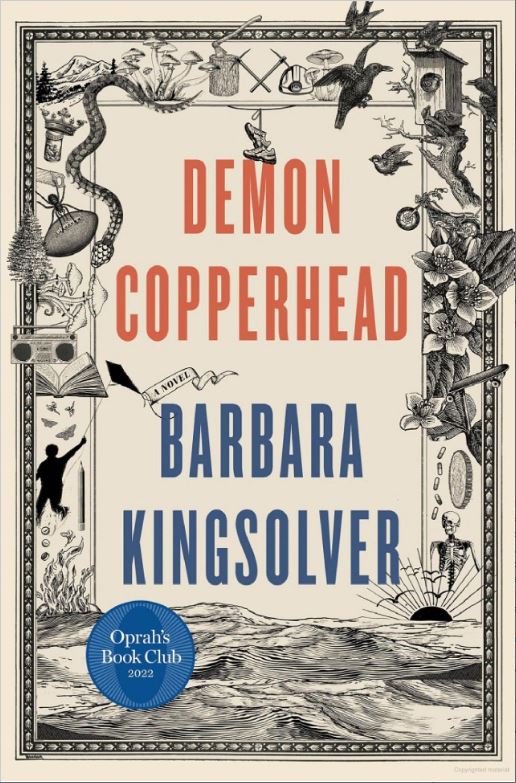
Anyway, the point is that I write very few book reviews these days. But I am moved to write one about the novel I just finished today: Demon Copperhead by Barbara Kingsolver. 

I'm not sure I'd even call this a review. It's more of a fangrrl thing.

Kingsolver has been one of my favorite authors ever since I read The Bean Trees. (It's a wonderful tale of a young woman from Kentucky who moves to the Southwest and, along the way, is given a little Cherokee girl under mysterious circumstances. There are a couple of sequels that are just as good as the first book.)

Demon Copperhead is a lot longer than The Bean Trees -- the new book clocks in at 560 pages. It also differs in that the new book is a modern-day update to Dickens's David Copperfield.

I read David Copperfield about a million years ago, but to be honest, I don't remember much about it. So I'm not really able to tell you about the parallels between the stories. (In its review, The Guardian does what I can't.) I can tell you, though, that it's not necessary to have ever read any Dickens to enjoy this book.

Demon, whose real name is Damon Fields, narrates his own story with a voice that is pure Appalachia -- and that's a good thing. The vast majority of the book takes place in Lee County, VA, in the extreme southwestern corner of the state. Demon lives with his alcoholic mother in a single-wide trailer owned by the Peggots down the road. He's forced to mother his own mother, getting her through her days, until she dies of an overdose on his eleventh birthday. Then he's thrown into foster care, enduring one bad situation after another -- abuse, child labor, drugs, the works. His luck turns and he becomes a star football player in high school, but a knee injury knocks him out for the season and the only real treatment he's given is a prescription for pain pills. This is the era of the opioid epidemic in Appalachia, and Demon and his friends all end up addicted.

Kingsolver takes an unflinching look at the foster care system and the damage opioids have done to the region. But to be honest, Appalachia has been forgotten, except as the butt of too many jokes, for decades. The opioid crisis is just the latest in a series of exploitations of the people who have lived there for generations; as someone in the novel observes, if it hadn't been OxyContin, it would have been something else.

The book is infuriating in places, too, as when we learn that none of the money from the opioid legal settlements has ever gotten back to the victims.

But it's not all grim. Kingsolver is masterful in describing the beauty of the land. And there are funny parts, as when Demon describes an outfit his friend Maggot is wearing: "...the neon mesh sleeves and giant black pants that he and his Batcave pals got at their Goth outfitters place over to Christiansburg. Chains all up and down the legs, so if you needed to put the boy on a leash you'd find many convenient attachment points."

Dickens shone a light on the ills of London society and helped to make things better for the downtrodden. I'm not sure Kingsolver's book will have the same kind of impact -- our society is too different, our attention scattered and our interests siloed -- but I hope it gets people's attention, if for no other reason than to convince folks to lay off the hillbilly jokes. As Demon observes, "We can hear you."

The Washington Post review says Demon Copperhead may be the best book of 2022. It's definitely the best I've read this year.

***

For those who care about that sort of thing, I paid for my copy of Demon Copperhead.

***

I'll do a crafts post next week, I promise.

***

These moments of bloggy book reviewing have been brought to you, as a public service, by Lynne Cantwell. Stay safe!
Sunday, July 17, 2022

Through a lens blurrily.

So for starters, I wanted to let y'all know that I'm going to be taking a blogging break for the next couple of weeks. I'm having cataract surgery on my right eye on Wednesday and on my left eye next week, and I don't know whether I'll be able to see well enough to write a post either next Sunday or the Sunday after that. 

This picture approximates what I'm seeing out of my right eye (the blurriness, not the crosshatching or other imperfections) right now.


As you can imagine, I'm pretty anxious to get this done.

I anticipate I'll get back to blogging Sunday, August 7th. If things don't go as planned for some reason, I'll put up a short post on the 7th to let you know.

***

So to while away the time until I can see properly again, I've been watching A Discovery of Witches. The book was recommended to me many years ago, and the show has been recommended to me since then, so I figured I ought to give it a try.

I have so many problems with this show.

For starters, hereditary witches aren't a real thing in our world; witches are simply humans who practice magic. The magic they've been doing in the show so far (I'm about halfway through season two) is pretty well divorced from reality, too. I can maybe see using five candles (for the points of a pentagram?) instead of four (for the cardinal directions) when you cast a circle. But why is Aunt Em not inside the circle herself? Casting a circle puts up a magical barrier, creating a safe space in which to work. It makes no sense to cast a circle that leaves the magic wielder outside it, and therefore vulnerable to interference. Besides, magic almost never results in the sort of special effects that you see in these sorts of shows. Rarely do you get whizbang pyrotechnics. At best, a spell will nudge something or someone toward the outcome the magician desires. 

To be honest, these kinds of depictions of magic set up unrealistic expectations, both for would-be magicians and for regular folks. When the "powers" on display in TV shows are so outlandish, it makes it difficult for newbies to tell whether their spell worked -- and easy for doubters to dismiss magic entirely.

Second, how can there be only three categories of "creatures" in the world? Vampires, but no werewolves? Demons, but no ghosts? No chupacabra? No La Llorona? There are so many different types of magical beings in folklore, but this series has, for some reason, narrowed them to just three.

Leaving aside all that: The main character is Diana Bishop, a normal young woman who eventually twigs to the fact that she's a powerful witch whose natural magical ability has somehow been suppressed. Regardless of her powers (or lack of same), though, she's still just a babe who needs to be protected; her favorite vampire, Matthew, is constantly trying to "keep her safe," no matter how many times she tells him to knock it off and no matter how many times she proves that she can take care of herself. It's such a tired trope that I've been about to hurl something through my TV screen multiple times.

And yet, as you so rightly observe, I continue to watch the show. 

I guess I'm invested at this point. I want to see how it all turns out. So I guess on that level at least, A Discovery of Witches works. Just don't expect to learn anything about magic from watching it.

***

These moments of blurry blogginess have been brought to you, as a public service, by Lynne Cantwell. Get vaxxed and boosted! See you back here in two weeks!

Sunday, July 10, 2022

Complicated winds.

You may recall that a few weeks ago, I attended a Q&A with the force behind the Game of Thrones TV series, George R.R. Martin, at the Santa Fe Literary Festival. He talked about the series he was developing with Robert Redford (yes, that Robert Redford) based on Tony Hillerman's series of mystery novels set on the Navajo Nation. And I said I was very much looking forward to seeing the show -- Dark Winds -- when it showed up on AMC.

Well, I've seen it. The sixth and final episode of the first season dropped today. And I'm torn. I want to like it -- I really do. The production company took pains to make sure Native Americans were involved in all aspects of the production, from showrunners to cast. That's a good thing. In addition, the show was shot on location here in New Mexico. Tesuque Pueblo, just up the road from Santa Fe, has converted its former casino building into a film studio, and Dark Winds was shot there, as well as at other locations around town. I was tickled to recognize Loretto Chapel (with its "miraculous" floating staircase) in downtown Santa Fe standing in for an Indian school run by nuns.

And I know that Hollywood does crazy things to novels to make them into properties that will bring eyeballs to either the big screen or the small one. But... wow. This show is so far afield from the world that Hillerman invented that pretty much the only things that are the same are the setting, the names of the characters, and their job titles (and even that last is not quite true).

The first season of the show is based pretty loosely on the third novel in the series, Listening Woman. I read the book probably 25 or 30 years ago, so I was pretty hazy on the details. But I checked out Wikipedia's plot summary this evening, and it confirmed my suspicion that not much of the book's plot made it into the TV show.

Oh, the framing of the story is more or less the same: Lieutenant Joe Leaphorn of the Navajo Tribal Police investigates the deaths of an elderly man and a young woman. The man had sought advice from a Navajo healing woman -- the "listening woman" of the title of the book; the young woman is the listening woman's niece. The listening woman steps away to ponder her advice to the man, and when she returns, both he and her niece are dead. They were murdered, of course, and Leaphorn eventually ties in their case with one a few years earlier, in which crooks blew the back off of an armored car in Santa Fe and escaped with the cash in a helicopter.

I won't go any farther with the plot because of spoilers -- not for the book (it was first published in 1978!) but for the TV series. I will say, though, that the showrunners had to do a major overhaul to bring in the other two main characters: Jim Chee and Bernadette Manuelito. You'll note that the cover of Listening Woman is billed as a "Joe Leaphorn Mystery"; that's because Hillerman hadn't invented either Chee or Manuelito yet. Chee first appeared in People of Darkness, the next book in the series. In his autobiography, Hillerman wrote that he created Chee because he thought Leaphorn was too hardened to fit the plot he had in mind for that book. But that's not what Martin said in May; he said Hillerman had signed an option to make the first three novels into a movie, and the document turned over all rights to the character of Joe Leaphorn to whoever owned the option. It didn't matter that the film was never made; Hillerman simply didn't own his character anymore. (Hillerman must have eventually gotten the rights to Leaphorn back, because he does show up in later books.)

In any case, Chee's not in Listening Woman, and neither is Manuelito. She doesn't show up until The Fallen Man, the 12th book in the series, published in 1996. After Hillerman's death, his daughter Anne has continued the series and has put Manuelito at center stage, along with Chee. (Leaphorn's now retired.)

In the novels, all three of them -- Leaphorn, Chee, and Manuelito -- are good cops. Their lives are as  complicated as anyone's, of course. But morally, there's no question that they believe in the work they do and in the Navajo way of life. And that's not always the case in the series. There are things that Leaphorn and Chee do in the TV series that they simply wouldn't do in the books.

I get it; moral ambivalence is the fashion now. Protagonists these days are messy, with complicated motives -- it makes them seem more real, or so the thinking goes. And if I'd gone into the show with no preconceived ideas about the main characters, I expect I would have liked it a lot.

But what I wanted from Dark Winds was a story about heroes and bad guys, and I didn't get it. Nobody here is a hero. 

***

***
These moments of complicated blogginess have been brought to you, as a public service, by Lynne Cantwell. Get vaxxed! 

Sunday, July 25, 2021

The Lord of Cries.

 I may have mentioned that this summer is shaping up to be a summer of vampires. The Atherton Vampire is live now at Amazon and on the Kindle app for iOS devices in the United States, and many thanks to those of you who have taken a look at Jerry's story so far. In addition, I'm in the midst of writing the second novella in the series. And last weekend, I saw the world premiere of The Lord of Cries, an opera based partly on Bram Stoker's classic novel Dracula, at the Santa Fe Opera.

I'm not a massive opera fan, but I've seen a number of them over the years. This one intrigued me not only because of the subject matter, but because librettist Mark Adamo has written a mashup of Stoker's story with that of  The Bacchae, a tragedy written by Euripedes that had its own premiere in 405 BCE. Adamo has been quoted as saying he was intrigued by Dracula's status as an outsider in Victorian London, which seemed to him to  correspond pretty neatly with Dionysus's status in The Bacchae

For those of you who haven't read the play, I'll recap: Dionysus is the Greek god of wine and wine-making, revelry, and religious ecstasy. His father was Zeus; his mother, Semele, was mortal. The kingdom of Thebes, under the rule of King Penthius, has forsworn his worship -- supposedly because he's not really a god due to his mixed parentage, but really because all the women in the kingdom, who are dubbed the Bacchae, are following him into hedonism. Dionysus wants Thebes to recognize him as a god, so he appears before Penthius as a stranger who supports the god's claim. Alas, Penthius cannot be swayed, so Dionysus decides to teach him a lesson -- one that leads to Penthius's destruction.

To get the Dracula tale to fit the bones of The Bacchae, Adamo made some key changes. He rolled Mina Harker and Lucy Westenra into a single character: Lucy Harker, wife of Jonathan Harker. In the novel, Jonathan comes back from Dracula's castle with his mind intact, but in the opera, he has been driven mad with, y'know, lust and stuff by Dracula's three vampire women. Also in the novel, Van Helsing is the main vampire hunter -- but here he's demoted to assisting John Seward, the head of Carfax Asylum and (because reasons) the de facto mayor of London. Seward is determined to do his duty and save London from Dracula, and that means denying his passion for Lucy. We discover that Lucy is also crazy about John, but she must do her duty and tend to her husband -- who, by the way, was driven insane because of the warring desires within his own soul. 

Into all this drama strides Dionysus in the guise of Dracula himself. He intends to wake up Victorian Londoners to the dangers of denying their baser instincts and desires in the service of "doing good", because that way, literally, lies madness. Neither Seward nor Lucy will abandon what they perceive as their duty, and so they are destroyed.

A lot has been made over the years of Stoker's setting for his novel. The Victorian era seethed with sexual repression, and literary critics have long seen Dracula as a target for fear and disgust because he challenged Victorian notions of propriety.

Of course, Adamo uses that. But what interests me, as a modern-day Pagan, is the vehicle he chooses for the message: a pagan god. In our present era, in which conservatives are fighting to repress social progress of all sorts, it's heartening to hear someone say that the pagans had it right.

***

These moments of bloggy ecstasy and ruin have been brought to you, as a public service, by Lynne Cantwell. Get vaxxed!

Sunday, May 23, 2021

Taking a pandemic breather to review.

geralt | Pixabay
It sounds like most folks had the same reaction I did to the CDC's recent declaration that anyone who's fully vaccinated can (mostly) stop wearing masks in public: Eh, not so fast. We're now at the point where either you throw caution completely to the winds and go without, or wear one anyway and risk those you meet thinking you're either: a) an anti-vaxxer or b) a Republican. I feel like I need to get a t-shirt that says, "I'm fully vaccinated but I have trust issues about everybody else."

I'd get a button, but I don't think all that would fit. Or at least not in a big enough font to be readable from six feet away.

Anyway, it appears that in the US, at least, as vaccination rates go up, the number of COVID-19 cases is going down, and the death rate attributed to the virus is going down, too. I don't want to jinx things by speaking too soon, but we may be emerging from the woods.

Regardless of how soon our lives can safely go back to normal, this seems like a good time to sit back, take a deep breath (masked or un-, your choice), and see whether we've learned anything from the past fourteen months. Robert Reich, who was Secretary of Labor under President Clinton, wrote a Facebook post earlier today that's a pretty good summary of the economic lessons learned due to the virus. While I agree with his list, I decided to come up with my own. There's some overlap, but I think he missed a couple of things.

1. How nice was it to show up, get your government-provided vaccine, and not have to pay a penny for it? Nobody asked for your insurance information. Nobody asked you for a co-pay. You didn't even have to contact the vaccine administrators to find out whether they were in-network or out-of-network. You just showed up, got the shot, and went on your way, right? Now think about how wonderful it would be if all health care in America was offered the same way. It can be -- if we would just institute universal health care. We're the only major nation that doesn't have it. It's beyond ridiculous. We need to do whatever it takes to get this done.

2. We need to continue to appreciate our essential workers -- and by "essential workers," I mean all the people who had to show up for work during the pandemic while the rest of us stayed safely at home: the health care providers, the delivery drivers, the warehouse workers, the grocery store clerks, the cashiers at stores deemed essential businesses, and the teachers who had to go back to in-person instruction not knowing for sure whether it was safe. Other than teachers and health care workers, most of these folks don't have job security -- they're typically not full-time employees and they receive minimal, if any, benefits from their employers. We need to fix that. At least give everybody free health care (see point 1).

3. I have zero patience for people who made a buck off of others during this trying time. I don't mean just the idiots who bought up all the hand sanitizer and wipes at the start of the pandemic and then tried to sell them for a premium -- although they're on my list. Nope, I'm also including the billionaires who have increased their wealth by more than $1.6 billion over the course of the past year and change. In many cases, their gain has come at the expense of their employees, many of whom are considered essential workers. Economic inequality was already off the charts in this country before the pandemic, and now it's worse. There's no excuse for that. 

4. As for the employers who tried to roll back hazard pay for their essential workers after a couple of months? Hello, the pandemic is still happening -- they still deserve that extra pay. And if you can't get people to come to work for you now? Maybe don't be so chintzy with your pay and benefits, and treat your employees like they're human beings and not interchangeable cogs.

5. When it comes to those who've been working remotely for the past year, now that they've had a taste of the good life, employers are going to have a hard time convincing them to go back to the office full-time. It was gospel at my old law firm that secretaries would never be able to work from home. Our job duties simply wouldn't allow it. Well, here we are, fourteen months into the pandemic in which everybody's been working remotely -- including secretaries at my old law firm. Not everybody thrives in the office fishbowl. Employers need to be flexible when it comes to bringing people back into the office.

6. I admit I wasn't nuts about the idea of having to wear a mask when it first came up. But when it became apparent that either I needed to mask up or hermetically seal myself in my apartment to avoid getting the virus, I got on board. But some people have been absolutely desperate to avoid reality, to the point where they have convinced themselves that masks are useless and the vaccine is dangerous. I'm all about "live and let live," as long as people's choices don't impact me. This does. If you're not going to get the vaccine, wear a mask. If you won't wear a mask, get vaccinated. And for gods' sake, don't lie about having gotten the vaccine so you don't have to wear a mask. 

7. The January 6th insurrection happened. It was not a "normal tourist visit." It seems logical to assume that anyone who objects to an investigation into what happened that day, including a thorough probe of who was behind it, probably has something to hide. 

Okay, that last point doesn't have much of anything to do with the pandemic. I'm leaving it on the list anyway. After all, this is just a draft. I'll come back to it once the virus has well and truly ridden off into the sunset.

***

Speaking of lists: How's your progress on our summer reading list? I'm not nagging, I swear.

In case you're wondering what I'm talking about, here's a link to the list and info on the contest. That's right! Prizes! Now go forth and read!

***

These moments of bloggy listicle creation have been brought to you, as a public service, by Lynne Cantwell. Get vaccinated and good luck!

Sunday, June 10, 2012

Families, functional and dys-.

My eldest daughter has been visiting for the past couple of weeks, bouncing back and forth between her father's house and mine.  This weekend she's staying with me.  It's the first extended one-on-one visit I can remember having with her since probably before she went off to college, and now she's 25.  It's a treat for a parent to find out how your kid turned out (particularly if the kid turned out well!).

We've had several family dinners while she's been here.  And yesterday I went with both of my daughters to see "The Avengers."  I've never been a comic book fan -- I'd rather read the words and let my brain draw the pictures inside my head -- so I wasn't all that familiar with the characters, other than the Hulk, who had his own TV show back in the '60s.  (And speaking of the '60s, when I hear the phrase "The Avengers," I don't think of comic book superheroes -- I think of John Steed and Emma Peel.)  But the movie was surprisingly good.

I also must admit that I haven't seen much of anything else Joss Whedon has been involved with.  Yes, it's true -- I've never watched "Buffy" (gasp!).  Just not that into TV these days.  But I was impressed with his work on "The Avengers."  Whedon has done a masterful job writing characters who work well together as a team, even though they have nothing else in common and, really, when push comes to shove, don't like each other very much.  (If you have not yet seen the movie, when you do, you must stay all the way to the very end.  There is a final scene after the credits finish rolling which you are sure to recognize, if you have ever sat through any sort of work-related "bonding" event.)  This mismatched team of heroes reminded me of nothing so much as a dysfunctional family, with griping siblings who rip each other to shreds but who band together when outsiders threaten any one of them.

Speaking of dysfunctional families, "The Avengers" comic books make Thor and Loki brothers.  That's not the case in the Norse pantheon, in which Thor is one of Odin's sons, while Loki might be more accurately called a Giant.  But the movie follows the comic books, and it's clear that while Thor has some love for his troublesome brother, he also wants to make sure he pays for his mischief.

Loki in The Pipe Woman Chronicles is a Giant, not a god.  He lives to cause trouble wherever he can get away with it.  And it's never a good idea to trust him. Which Naomi might eventually figure out....

*****
A couple of newsy things:  You might have noticed a new cover in the slide show to the left.  Fissured is still on track for publication at Amazon August 18th, and to promote it, I'll be participating in the Orangeberry Summer Splash event in late August.  Dates and links are now up on the "Tour Dates" tab.

I've also got a guest post up at the Indie Exchange this weekend.  Feel free to stop by if you'd like to know about the question I most dislike answering.

And if you have an e-reader that's not Amazon-spawn, watch this space next week for good news about Seized!
***
I'm , and I approve this blog post.

Friday, November 25, 2011

Success! and a review.

First:  It's not official yet (i.e., I haven't yet dumped my novel into the validating software), but my NaNo novel topped the 50,000 word mark earlier this week.  Go me!

Second:  Besides being NaNoWriMo, November is also Adopt an Indie Month.  This effort was begun (as I understand it) by a lovely lady in the UK.  The idea is that authors can submit their books for review, and then bloggers and other readers can "adopt" the book and review it.  I found out too late to submit SwanSong this year, but I did agree to adopt another book.  That book is called Finder, by Terri-Lynne DeFino.

Finder is an epic fantasy with a romantic twist.  The main character is Ethen, the Finder of the title.  Ethen has a talent for Finding things or people.  He can hold something related to the lost item, and in his mind's eye he will see an image of its location and maps that will lead him there.  That ability leads him from a life on the streets to a life of ease, but on the way, he finds and loses something very precious to him -- his soul mate, Zihariel.  She is a renowned musician whose playing evokes strong emotions in anyone who hears her.  She is also a pooni, a race enslaved by the ruling Therks.  When she runs away from her master, he hires Ethen to Find her.

I very much enjoyed this novel, especially the second half, when Ethen and Ziharial are no longer callow youths beset by their first big rush of hormones.  So many fantasies follow the track of the hero myth -- child (usually a boy), destined for greatness, sets out on an epic quest to find (insert magical object here) and finds him/herself in the process.  It's refreshing to read a story, especially a love story, that features characters in their prime.

The love story is set against a backdrop of a desert kingdom in which spices are a controlled substance and participating in the spice black market can get one killed.  This secondary plot is what drives the novel to a satisfying conclusion.  Go and find Finder -- I think you'll like it, too.