Showing posts with label Stephen R. Donaldson. Show all posts

Sunday, August 28, 2022

On violence in the media.

Apparently I've been inadvertently assigned to the George R.R. Martin beat. Earlier this year, I blogged about his appearance at the inaugural Santa Fe Literary Festival. This weekend, I attended Bubonicon, a science fiction and fantasy convention in Albuquerque, where Martin was given an 80-minute slot for connecting with his fans. A lot of authors will use such time slots to do a reading of their work, particularly if they have a new book out or one is coming out shortly. Eighty minutes is super generous -- usually an author gets maybe a half-hour or an hour. Only one other author got that much one-on-one time this year: Stephen R. Donaldson, who is my all-time favorite fantasy author. Donaldson did a reading from The Killing God, the final book in The Great God's War trilogy that will be out this fall, and answered questions. Of course, I very much enjoyed it.

Martin did neither of those things. He hasn't had a new book out in several years, although he assured us that he's continuing to work on The Winds of Winter, the long-awaited sixth novel in the series on which the TV show Game of Thrones is based. And he didn't take questions (probably because a lot of the questions would have been about The Winds of Winter). Instead, he spent a few minutes bringing us up-to-date on his various TV and film projects, including House of the Dragon, a GoT prequel that has just begun airing on HBO, and he mentioned that he'd caught COVID and had to skip the premiere as well as some other promotional events because he was quarantining. Then he spent the rest of the time talking about violence.

Andrew Martin | Pixabay

He started off talking about how violence was portrayed on TV in the '50s and '60s, when he was a kid. In kiddie Westerns, the gunfight always ended with the hero shooting the gun out of the bad guy's hand, a trick shot that in real life would be unlikely at best. In prime-time Westerns, the hero shoots the bad guy once and, bloodlessly, he falls down dead -- which never happens in real life.

From there, he went on to his early career in TV writing, which included the show Beauty and the Beast. I admit that I was a fan of the show, and had in fact blocked out any memory of the final season, when Laura Hamilton quit (Martin didn't say why she left; Wikipedia says she was pregnant). Martin told us the censors gave them a hard time -- Vincent (played by Ron Perlman) was a noble lion-man who went berserk when angry, but the censors wouldn't let him tear anyone apart. So he was only allowed to throw bad guys across the room. (I'm tempted to find out if the show is streaming somewhere to rewatch it and see if that looks as goofy as it sounds.)

Anyway, it's quite a jump from Vincent growling and tossing bad guys around to the red wedding in GoT. Decades passed between them. And besides, you can get a lot more of everything on cable -- more sex, more drugs, more cursing, and more violence.

Martin acknowleged that he's gotten a lot of flak for the violence in GoT. And he knows there have been studies about how many violent scenes kids view these days. But he reasons it this way: If you want to watch what he calls comfort TV, which contains nothing that disturbs you, that's a valid choice. And it's a valid choice for content producers who only want to make comfort TV. But he says if you're going to choose to include violence, it needs to be realistic -- not the bloodless Old West shootings of the '50s and '60s.

I have Opinions.

I haven't watched GoT -- or rather, I watched the first episode and never went back. The degrading sex scenes grossed me out, but the thing that really did it for me was when Jamie Lannister nonchalantly pushed little Bran off a wall a couple of stories off the ground. I'd read all the Song of Ice and Fire books and I knew it was coming, but seeing it was too visceral for me. And because I'd read the books, I knew it would only get worse. So I bailed.

I'm not trying to be a paragon of virtue or a snob, mind you -- I'm only speaking for myself and my own taste. There are so many movies and TV shows that are supposed to be great that I haven't watched. Taxi Driver. The Sopranos. Breaking Bad. Graphic sex and violence just don't interest me. And I don't think either one is necessary to tell an intriguing, complex story.

This kind of reminds me of the time years ago when we began to discover that entertainment stars had feet of clay. Back in the heyday of the movies, the big studios had publicity departments that were in charge of the stars' images. They'd encourage the idea that a starlet and a leading man were dating, for instance, or quash any rumors about an actor's drinking or sexuality. When the publicity machines went by the wayside in the '60s, we began to learn that our favorite actors and musicians got drunk, got high, and did all sorts of scandalous stuff. The entertainers always say they're entitled to live their lives however they want. They aren't up there to be a role model for anybody. They certainly aren't responsible for teenagers who try to walk on the wild side -- that's the parents' job.

To be clear, Martin didn't explicitly say he had a right to produce anything he wants, the opinion of society be damned. But he didn't really address it, either; he mentioned the abundance of violent programming available for people to watch today and just kind of shook his head. Never mind that numerous studies have shown that viewing violent media content can increase aggressiveness in both children and adults and desensitize viewers to violence.

I'm not saying Martin should dial it back; he's free to make whatever programming he likes. But in a society where gun violence was the leading cause of death for children in 2018, maybe a little less realism on TV wouldn't be a bad thing.

***

These moments of visceral blogginess have been brought to you, as a public service, by Lynne Cantwell. Stay safe!

Monday, November 9, 2015

The World Fantasy Convention Report.

This year's haul is noticeably smaller than in years past.
Warning: If you're looking for nuggets of writing advice, they're here -- but you'll have to put up with a fair amount of fantasy-fiction name-dropping and some fangrrl squeeing before we get there.

Sorry that I'm a day late in posting this week. Today is my World Fantasy Convention hangover day. I've been to enough of these now that I've learned to build in a post-convention day off, to help ease my re-entry into the normal world. This strategy first paid off after the WFC in San Diego, where guest of honor Neil Gaiman was treated like a rock star. I described this to an attorney I was working for, whereupon she said, "I don't know who that is." If we'd had that conversation the day after convention's end, I might have broken down sobbing. As it was, I was able to feign a simple case of mild surprise. (The sobbing came later, in private.)

This year's convention felt kind of thrown together from the start. There were fewer than the usual number of communiques from the organizers before the convention, and the book bags were a lot smaller than usual. At past conventions, I'd received between twelve and fifteen books in my bag -- some ARCs (advance reader copies), some overstocks, some because the author was a guest of honor. My hardback copy of Gaiman's American Gods came in my book bag in San Diego. This year -- well, reference the photo above. I bought the Donaldson volume in the dealers' room; four of the others came in my bag, together with a paperback copy of a book I got in hardback last year (David Baldacci's The Finisher) and a mass-market paperback of a book I'd received in my bag a few years ago (Peter Brett's The Warded Man). I picked up the Novik from the book exchange table. The author of Without Bloodshed, Matt Graybosch, told me his publisher had ordered enough books for every bag, but never heard where to send them or when the deadline was.

(The peppermint pig wasn't in the bag, either. It was a freebie at the registration desk.)

Anyway. As a member of Broad Universe, I participated in their Rapid Fire Reading Thursday afternoon. I had about five minutes to read, and chose the scene from Dragon's Web in which Rafe first meets Sage's father at the pizza place. I was gratified that the audience laughed in all the right places. (Note to authors: Broad Universe has a special rate at NetGalley, and you don't have to be a speculative fiction writer -- or even a broad -- to take advantage. The rate is $25/month for members and $45/month for non-members. Full details here.)

Once my reading was over, I was able to relax and be a fangrrl. Of course, that meant attending every panel Stephen R. Donaldson was on, and first up was a geek girl twofer: Donaldson interviewing guest of honor Steven Erikson, whose ten-book Malazan Book of the Fallen series is well on its way to becoming a classic of the grimdark subgenre. (Yes, grimdark is an actual thing.) Erikson's books are doorstop-sized tomes, running a thousand pages or more. He explained that he kept his editor from cutting them down to size by insisting that this scene here in book A was crucial to understanding a scene in book G -- which may or may not have been true. Donaldson (who has been known to say, of his own ten-book series, "internal consistency is a bitch") wanted to know how Erikson keeps all the details straight -- to which Erikson said, "Oh, please - when one character changes gender? Twice?" Turns out he has great intentions about note-taking, but lousy follow-through; the assistant he hired to organize all the details of Malazan discovered 50 or 60 notebooks, each containing about three pages of notes.

I ran into YA fantasy author Sarah Beth Durst in the elevator, and later saw her on a panel with Donaldson about whether quest narratives are in or out of fashion. Sarah, bless her heard, said she really enjoyed The Martian because everyone in it was so nice -- prompting Donaldson to blurt, "I was so bored!" He then invoked the spirit of Lester del Rey, who ran the Del Rey imprint at Ballantine in the 1970s and '80s. Donaldson said del Rey believed there were three types of conflicts in fiction -- man against others, man against nature, and man against himself -- and that while just one will make a good story, you need to include all three for a great story. Clearly, in Donaldson's estimation, The Martian fell short.

The other "quest" panel I attended was not nearly as interesting. Moderator Jeanne Cavelos, who runs the venerable Odyssey workshop program, kept a tight focus on the topic of what to take on a quest -- even though authors Carol Berg and Catherine Cooke Montrose kept trying to steer the discussion away from a packing list into more interesting territory. After all, the key element of any quest is the questers themselves: not the physical things they bring along, but how they survive, what they find, and what they bring back with them -- and that includes self-knowledge and maturity as much as it does whatever McGuffin the party has been sent off to fetch.

Finally: Walking back from the art show Saturday night, I stumbled across an impromptu concert featuring six or eight convention attendees (one of whom, I learned later, was Charles de Lint). Among the songs they sang was one called "The Family Car". I didn't get a video, but here's one of some other people performing it on "The Prairie Home Companion" a few years back.


Yes, there's irony in people who work in traditional publishing singing heartily about the car as America's safety net. Publishing is a tough business, no matter how you do it.

***
These moments of convention-addled blogginess have been brought to you, as a public service, by Lynne Cantwell.

Sunday, February 22, 2015

When the rules don't apply.

Reading can be a subversive exercise. Sometimes it encourages you to break the rules.

I just finished a book that I received in my book bag at last fall's World Fantasy Convention:  Lifelode by Jo Walton. I'd never read anything by Walton before this, so I didn't really know what to expect. But the book's description appealed to me -- it's set in what appears at first glance to be a fantasy world. Applekirk is more or less a castle, and those who live there more or less practice magic, which is called yeya in the world of this book. There are some peculiarities in this world: the farther East you go, the more yeya there is and the more time speeds up; the farther West, the more time slows down, and yeya becomes a rumor, or maybe even a fairy tale. But the oddest thing at first glance is that the book is written in present tense. And it works -- or at least, it worked for me, because one of the main characters views time in a non-linear fashion. Often when she looks at someone, she sees a sort of ghost or shade of their past or future self, so that everything happens at once, all the time.

Now, writing in present tense is not a usual choice for authors. Sure, Suzanne Collins uses it in her Hunger Games books, but by and large, the default is past tense. And the intarwebz are full of reasons why you should stick with past tense (although I would argue that a competent writer -- like, say, Walton, for instance -- would easily avoid the pitfalls listed in this Writer's Digest article).

It turns out that Walton stretched another boundary, too. While at first glance, Lifelode is fantasy, Walton says in the Q&A at the end of the book that it's definitely sci-fi. The novel's world is actually a pocket universe -- a fold in space-time -- which explains why time passes faster, the farther east you go. I don't know that you need to know that to enjoy the book; you can certainly read it as fantasy set in an odd magical world.

This tweaking of expectations is also evident in Ann Leckie's Ancillary Justice, which was my Rursday Read this week. This book is very definitely sci-fi -- spaceships, aliens, and artificial intelligences abound. Leckie's protagonist, Breq, was once part of the AI that operated a spaceship, which may be mind-bending enough. But the people of the society that created the ship have the capability of becoming either gender -- so their language has no gender. Leckie could have taken the easy way out and denoted this by having Breq use "it" as his/her default pronoun. But instead, it's "she". It's a little disorienting, and a constant reminder that the reader's not in Kansas anymore.

Both of these authors are multiple award winners. Leckie's book won the Hugo, the Nebula, and the Arthur C. Clarke awards last year. Walton's past work has also won the Hugo and the Nebula.

I'm bringing this up because I saw a bit of advice on Facebook this week about how you shouldn't use big words in your fiction writing. Supposedly, it's because throwing a bunch of unfamiliar words at your reader will throw them out of the story. Now, usually I'm on board with this advice; after all, I spent a lot of years writing radio copy. For that, you use short words and simple sentences because when you're writing for the ear, clarity is key. But fiction is a different beast, and sometimes complexity is better. One of my favorite authors is Stephen R. Donaldson, whose Thomas Covenant books are rife with unfamiliar words. Donaldson has said he used the difficult vocabulary in part to make it clear that the Land is not our world. And Donaldson's work has won numerous awards, too.

So we have three authors who have won a boatload of awards for breaking the rules. It's probably no accident that these three authors write speculative fiction, where rule-bending of all sorts is allowed, and even encouraged. But I think the takeaway is that each of these authors had a good reason for doing what they did. Donaldson used unusual words to set the Land apart from our world. Leckie's Breq calls everyone "she" to underscore his/her alien origins. And Walton uses present tense to reinforce the idea that time moves oddly in her world.

So if you're tempted to bend or break a writing rule, have at it. But don't just do it to do it. Know what the rule is there for, and figure out why it doesn't apply in the case of your story. After all, that's how the award-winning authors do it.

***
Speaking of awards: Congrats to Birdman on winning the Oscar for Best Picture tonight! (Did I call it, or did I call it?)

***
These moments of rule-breaking blogginess have been brought to you, as a public service, by Lynne Cantwell.

Sunday, October 12, 2014

WFC dreaming, or: the weekend I was nearly famous.

We'll get to our post in a moment. But first, the news:

  • The Land, Sea, Sky Trilogy is now live at Amazon. This omnibus edition includes a new author's note and the first chapter of Seized, just in case readers get to the end of the book and want to know why Antonia treats Naomi like a rock star. If you enjoyed the Land, Sea, Sky books -- or if you have been meaning to get around to reading them -- now's your chance. And not that I'm encouraging anyone to wait...but starting this Thursday, the omnibus will be on sale for 99 cents. I hope you'll check it out, and tell all your friends, too.
  • The fractal jaguar is having his moment in the sun this weekend. The book trailer for Fissured is featured at Indies Unlimited today. Click through if you haven't seen it -- or, heck, if you'd like to see it again.
  • I received an e-mail this week from the organizers of this year's World Fantasy Convention, notifying me that "A Man's Got to Do What a Man's Got to Do" has been selected for inclusion in Unconventional Fantasy: A Celebration of Forty Years of the World Fantasy Convention. The anthology will be recorded on a thumb drive and given to everyone who attends the convention next month. I happen to know that a whole bunch of my fantasy-author heroes also have pieces in this anthology, so I am fairly giddy about being included. 
Which segues nicely into this week's post, in which I reprise (with a tweak or two) a thing I wrote for Indies Unlimited a few weeks ago.

***
I don’t mean to brag, but I had 850 people show up at my first book signing.
Okay, they might have been there to see Gene Wolfe, or Stephen R. Donaldson, or Elizabeth Bear, or Peter Straub, or Patricia McKillip, or…well, you get the idea. But I was there, too!
“There” was the 2010 World Fantasy Convention, in Columbus, Ohio. This annual convention travels to various venues around the world – last year’s was in Brighton, England – and is geared toward speculative fiction in general and fantasy in particular. Membership is capped at 850, and many of the attendees are authors, agents, and editors.
Watchers with SRD in 2010.
I went with some friends from Kevinswatch, and we all went because Donaldson was going to be there. But one of the questions on the sign-up form was, “Are you an author?” This was right after Calderwood Books had published The Maidens' War, so I checked “yes” and put in the Calderwood Books website since I hadn't really started blogging yet. Not only did the WFC organizers believe me, but they put me on a panel. And they let me sign books with the big guys on Friday night.
I've mentioned the mass autographing session here at hearth/myth before. It's a World Fantasy Convention tradition, and it’s pretty crazy. They set up long tables in a ballroom-sized conference room, and they give you a table tent with your name on it. Seating is first-come, first-served, and the lines to get a popular author to sign books can be long. When Neil Gaiman was an honoree in San Diego in 2011, the line to see him wrapped around the ballroom. There were, in fact, so many people in line that he couldn't get to everybody; the convention organizers had to set up a second signing later in the weekend just for him.
Then there are the dealers, who set up outside the room with crates of unsigned books and send runners with stacks of books into the autographing session. The runners stand in the lines, get the books signed, and bring them back to the dealers – who, of course, charge more for autographed books.
There was no line in front of my table, alas, and none of the runners had The Maidens' War in their stack. But my friends gathered around my table, had me sign their copies, and chatted as if I was an actual somebody. One of my buddies even took my picture as I signed his book. I caught at least one passer-by eyeing my table tent to try to figure out who the author was who had attracted such a crowd.
It was really hard to go back to the day job the following Monday, let me tell you.

I'm not expecting such a rousing success this year. For one thing, I won't be a starry-eyed newbie. Well, okay -- I'll still be starry-eyed (I mean, jeez, Guy Gavriel Kay is a guest of honor!), but at least I won't be a newbie. Still, I'm looking forward to this year's shindig. For one thing, my travel and hotel costs will be minimal, as it's happening ten minutes from my house. For another, I get to be in an anthology with Donaldson. "Nearly famous," indeed!

***
This post originally appeared in a slightly different form at Indies Unlimited.
***
These moments of nearly famous blogginess have been brought to you, as a public service, by Lynne Cantwell.

Sunday, June 29, 2014

What I did on my summer vacation (fangirl squee!).

Me, asking Donaldson his opinion of indie publishing.
I may have mentioned once or twice that my all-time favorite fantasy series is The Chronicles of Thomas Covenant the Unbeliever by Stephen R. Donaldson. I read the first three books when I was in my 20s, just a few years after they were published. A college friend recommended them to me, but it wasn't until after I had graduated that I ran across them at the library, checked them out, and was hooked. The main character, Thomas Covenant, is an anti-hero: a cynical leper who finds himself plopped down in a wondrous land where he is cured of his disease, amidst people who believe he is some kind of hero. He fights the temptation to believe it's real, all the while pondering whether his own actions matter in a place he may have invented in his own head.

Those first three books redefined the genre of epic fantasy, which up until then had consisted of Tolkien's work and not much else. Donaldson followed up a few years later with the second three books of the Chronicles. He put off writing the final four-volume set until about twelve years ago; the final Covenant book, The Last Dark, came out last fall. In between, Donaldson wrote a high fantasy duology called Mordant's Need; the Gap cycle, a five-book sci-fi series; a couple of short story collections; and, as Reed Stephens, three mystery novels. (The mysteries, including a new fourth book, were republished under his real name a few years ago.)

In 2000 or so, not long after I started at my current day job, I ran a web search for information on the Chronicles. Donaldson didn't have a website (he does now), but I found a couple of fan sites. One of them was Kevinswatch, and among its features was a discussion board on the EZ Board platform. I joined more or less immediately. A couple of years later, when the EZ Board ads became too annoying, a member in New Zealand offered us space on his server, and that's where the Watch has been ever since. Over the past decade and a half, more than 3500 people from all over the world have joined the Watch, including Donaldson's webmaster, his beta readers, and the camera operator for the hilarious public-access TV show "Fantasy Bedtime Hour" (you can watch the episodes here -- Donaldson appears in three). The board has grown as well, expanding from the original Chronicles discussion threads to include separate forums for food, history, literature of all types (Donaldson fans, it turns out, are quite the well-read bunch), fan art, music, sports, writing, politics, philosophy, and games, including our own role-playing games. (And I've probably left something out.) In short, it's a community. Watchers have been known to remark that the Watch is one of the nicest places on the internet. Even our political forum is less rough-and-tumble than others of that ilk (or so I've been told).

It's entirely possible that had I never joined the Watch, I would not be a published author today. In 2006 and 2007, we created three anthologies of our own work. When our editor, Joy Calderwood, set up Calderwood Books, she asked me for the reprint rights to two of my stories from those anthologies. Then she published The Maidens' War in 2010. Thanks again, Joy, for believing in me.

One of our members lives in Albuquerque, where Donaldson also lives. In 2004, Danlo offered to host a sort of mini-convention at his house for whoever could make it, with the big draw being dinner with The Author. I missed the first Elohimfest, but I've made all the others, as well as a couple of regional gatherings. Many Watchers are now among my closest real-life friends.

Last weekend, we gathered in Albuquerque for Elohimfest 4. Nearly 40 Watchers from across the US and around the world (Australia, Ireland, the UK and Finland) attended. And on Saturday night, during the Q&A, I finally got up the nerve to ask Donaldson what he thought of indie publishing.

Maybe it was the venue, or the fact that I've now met him several times. But his response was much less dismissive than comments I've seen from many other traditionally-published authors. I can't give you a direct quote -- the video isn't up at his site yet, and I was too distracted to take notes -- but he recognized the sorry state of corporate-owned trad publishing, and he said indies and on-demand publishing might well save the industry.

Bless you, sir, for your kind comments, and for your books, and for being the catalyst behind the creation of the Watch. 

***
Edited to add a link to fellow Watcher Rob Hope's take on E-fest, just so y'all know I'm not the only person who waxes rhapsodic about the Watch.

***
These moments of bloggy fangirl squeeing have been brought to you, as a public service, by Lynne Cantwell.

Sunday, June 22, 2014

A brief hearth/myth hiatus.

Apologies for the lack of notice, guys. A lot was going on last weekend, and so I forgot to tell you that I would be taking this week off. As you read this, I'm in New Mexico for what is likely to be the final Kevinswatch.com Elohimfest, given that Stephen R. Donaldson published the final book in the Chronicles of Thomas Covenant the Unbeliever last fall.

However, you may rest assured that I will be back here next Sunday as usual, and then will be able to give you a full report on the 'Fest.

So until June 29th, happy reading!

***
This brief moment of vacationing blogginess has been brought to you, as a public service, by Lynne Cantwell.

Sunday, June 8, 2014

Scorched Earth is coming. Now what?

As promised, the final installment in the Land, Sea, Sky trilogy, Scorched Earth, will hit virtual bookshelves sometime mid-week. I'm aiming for Wednesday, June 11th, but it might be a little sooner than that, depending on how quickly Amazon and Smashwords can process the file. I'm still putting the finishing touches on the manuscript, but I fully intend to upload the e-book files before I go to bed tonight.

As part of the celebration for finishing the series, I'm throwing a little party on Facebook. Consider this your invitation to stop by on Saturday, June 14th, between 1:00pm and 3:00pm Eastern time. Just like with the party for the Undertow launch, we'll have some games and music, and there will be prizes. A whole bunch of my indie author friends have given me copies of their books to give away -- I'll be previewing them on the event page all week -- and I have some other prizes lined up, too. Hope you can join us.

Of course, I couldn't leave my blog readers out. So you will see below a Rafflecopter for a $25 Amazon gift card and two $5 Amazon gift cards.

You will notice that one of the entries is a poll question. You see, I'm not the kind of writer who has a drawer full of writing prompts. Instead, I start one book and pursue it to completion, and then cast around for something else to write about. I used to feel like I was doing it wrong. But then I found out Stephen R. Donaldson, who's been writing novels for a lot longer than I have, is the same way. If the system works for him, I decided, it can't be all bad.

But here's the thing: once I pull the trigger on this book, I will need something else to work on. This is why I like writing series -- I don't have that floundering feeling when I finish a book because I've always got the next one teed up. Unless, that is, it's the final book.

I wouldn't be dithering now, but my editor asked me the other day whether I was interested in doing Camp NaNo with her in July. I hadn't planned on it, but if I can come up with an idea before July 1st, why not? 

I have come up with a couple of not-even-half-formed ideas. I could write about Naomi's kids, Sage and Webb, but I'd like for them to get a little older first. I could also do something else with Tess, Sue, and Darrell; originally, I'd planned to be done with them after these three books, but they are all moving on to new chapters in their lives at the end of Scorched Earth and Darrell's new gig, at least, could be pretty interesting. I could also write a completely new fantasy series that I've just started thinking about. Or I could try writing a novel of magic realism; I don't have any more to go on than that at this point, but heck, Seized began as a challenge to myself to write an urban fantasy, and you see where that's gotten us.

Or I could take the rest of the summer off.

Anyway, feel free to give me your opinion. Vote in the poll and/or leave me a comment below. Thanks, and good luck!

The Rules (sorry, gotta have 'em):

1. Friends and family may definitely enter.
2. Winners from my previous contests may win again.
3. Someone will win.
4. As always, the judge's decisions are arbitrary, capricious, and final.

P.S. As promised, the Kindle edition of Summer Dreams is now available at Amazon for 99 cents. Just as with 13 Bites, we're giving all the proceeds to children's literacy programs.

a Rafflecopter giveaway


***
These moments of bloggy celebration have been brought to you, as a public service, by Lynne Cantwell.

Sunday, May 5, 2013

Wherein we discuss magic realism, or: busted.

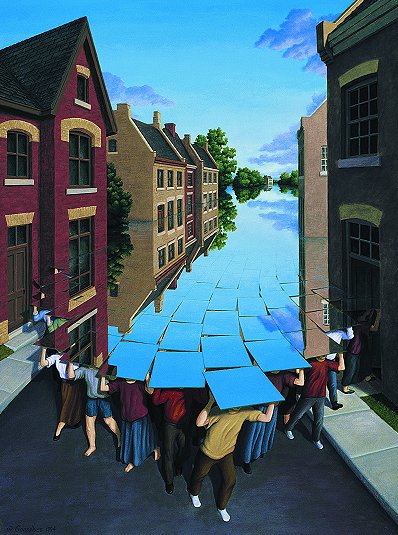
Here Comes the Flood - Rob Gonsalves
This is what happens when I shoot off my mouth.  I should know better by now.

On Friday, I wrote a little post for Indies Unlimited that was based a creative writing professor's takedown of another creative writing professor's comments about the current crop of creative writing students.

You with me so far?  Okay. To proceed, then:  The author of the original article was dismayed that his students don't read much in the way of contemporary literary fiction.  (Contemporary as in "written and published today," not necessarily as in "the setting of the story is the present day.")  The author of the article I mentioned in my IU post said that was a rotten idea.  He said basically that writers are a dime a dozen these days (and that is different from any other time in history how, exactly? But I digress...), and that creative writing programs are so successful in bringing lousy writers up to competency that it's natural for some of these barely competent writers to get published.  (My response to that is that if the gatekeepers are doing their jobs, then shouldn't the barely competent be rejected in favor of the extremely competent with some regularity?  But I digress again....)

Anyway, his point is that current literary fiction is banal at best, and not very good at worst -- and that writing students would be better off reading the best of any genre, not just the allegedly hoity-toity stuff.

Now that was a statement I could wrap a blog post around.  And so I did.  But then in that post, I made the mistake of referencing my famous rant about how magic realism is nothing but fantasy with an accent.

Karen Wyld, who is Aborigine and who writes magic realism, quite rightly took me to task for it.  Her post on her own blog in defense of magic realism is here.  It's terrific.  You should click through and read it.  But basically, she says (and I hope I don't get myself in trouble again for paraphrasing...) that magic realism grew out of the storytelling tradition, and that the genre was created by the dispossessed, or their descendants, as a way of explaining to others what they could not explain in any other way.  The magic in magic realism is intended to bring the reader into the writer's world, to let the reader feel what the writer feels about his or her lost land and way of life.

She's right, of course.  One need only think about books like Laura Esquivel's Like Water for Chocolate or Toni Morrison's Beloved, or anything by Gabriel Garcia Marquez, and see how the magical events in these stories are there to evoke an emotional response in the reader.

But my original point was that the best fantasy writers do the same thing.  It's certainly true that a lot of them use magic simply as gee-whiz window dressing.  But the really good ones use it as a device to develop the characters' personalities and to underline their flaws -- and to evoke thereby a specific emotional response in the reader.  I keep going back to Stephen R. Donaldson because he's one of my favorite authors -- but he's one of my favorites because he's so damn good at this kind of thing.  Terisa Morgan surrounds herself with mirrors in order to convince herself that she's real; then a magic mirror becomes her portal to adventure and allows her to conquer her fear.  Thomas Covenant, stripped of everything that means anything to him, is brought to the Land, where he has unimaginable power that he never asked for and cannot bring himself to trust; he struggles to find a way to use this newfound power without betraying himself.

When I was in grad school, this frustrated me.  Any fantasy novel was dismissed as crap because, you know, it had magic in it.  But if a foreign author wrote a book that had magic in it, well, then, we can call it magic realism and it's okay to read -- the magic is there to explain why us white folks should feel bad about conquering these other cultures.  So it's not really magic -- it's a literary device.  It's allegory.  Or something.

It's insulting, is what it is: insulting to writers of both magic realism and serious fantasy.  Good writing is good writing, period.  Why we have to shove it into little labeled boxes and turn our noses up at one while lauding another escapes me.

Anyway, to be clear: magic realism isn't just fantasy with an accent.  But fantasy isn't dreck by definition, either.

***
In other news, and speaking of fantasy and Stephen R. Donaldson, I hope you saw my interview at John Pythyon's blog earlier this week.  It was a ton of fun to do, and I think it turned out really well.

And you may have already heard that I sent off Annealed to my editor last night.  Yay for progress!

***
This moment of bloggy clarification is brought to you, as a public service, by

Sunday, August 19, 2012

Welcome the jaguar, and a contest.

This week's news:
  • Congrats to Danee Hayungs, who won a copy of SwanSong in the Goodreads giveaway.  I'll be dropping the book in the mail tomorrow.
  • My very first official staff post went live at Indies Unlimited this week.  The subject is a serious but little-known syndrome suffered by indie authors, and we all hope you give generously so we can continue to suffer from it. ;)
  • More fun with Animoto: I decided The Maidens' War needed some love, in the form of its very own trailer.  You can see the result over on the left there.
But of course, the big news is the release of Fissured: Book Two of the Pipe Woman Chronicles.  It's currently available at Amazon, Smashwords, and the Nook Store. I fully expect Smashwords will be sending it out to iBooks, Kobo, and their other affiliates within the next week or two.  Oh, and you can get a paperback copy from CreateSpace.

Major thanks to those of you who have already picked up a copy!  You are all my new best friends!

Starting Friday, I'll be on (virtual) tour for Fissured as part of the Orangeberry Summer Splash.  My first stop, at Nyx Book Reviews, will feature an interview with me, which I am posting for your convenience below.  Your assignment, should you choose to accept it, is to answer one of the questions below better than I did.  (Answer it as yourself, not as me!)  Post your Q&A either in the comments here, or on my Facebook page.  I'll award to my favorite a free copy of Fissured in the format of the winner's choice.  And as a friend used to say: the judge's decision is arbitrary, capricious, and final.

Here are my answers.  Go.
***
If you could invite any 5 people to dinner, who would you choose?
Four of them would be my grandparents.  Both of my grandfathers died before I was born, and my maternal grandmother died when I was six years old.  Now that I’m old enough to hold a conversation, I’d like to meet them.  Then I would try to stretch the guest list so that both my mother (who died in 2008) and father (who died in 1984) could come, too.
What is your favorite flavor of ice cream?
Once upon a time, a company called Barracini made a flavor called cherry amaretto almond.  That stuff was amazing.  Unfortunately, I haven’t been able to find it in probably twenty-five years.  These days, I settle for Turkey Hill Philadelphia Style in any flavor but strawberry.
What is your favorite thing to eat for breakfast?
A breakfast burrito from a street vendor.  But usually I have to settle for cereal.

Night owl, or early bird?
Night owl, for sure.  I can get up early if I have to, but I’m basically sleepwalking until about 8:00 a.m.

One food you would never eat?
Liver.  Ugh.  It even smells bad while it’s cooking.
Skittles or M&Ms?
You really know how to hurt a woman.  Today, almond M&Ms.  But tomorrow it might be Wild Berry Skittles.

Please tell us, in one sentence only, why we should read your book.
I had a lot of fun writing it and I think you’ll have fun reading it.

Any other books in the works? Goals for future projects? 
I’ve got three more Pipe Woman Chronicles books on tap.  I’m planning to write the third book during NaNoWriMo this November.  My original plan was to publish two books a year, but I might try to finish the final three next year.

What was your favorite book when you were a child/teen? 
I loved Little Women until I read Jane Eyre when I was in eighth grade.  Mr. Rochester proved to be a lot sexier than Mr. Bhaer.

If you could be one of the Greek Gods, which would it be and why?
Can I pick a different pantheon?  I would be Lugh, the Celtic god of light.  He was good at everything!  Plus, he’s the patron god of storytellers.

If you could live anywhere in the world, where would it be?
There’s a reason why the Pipe Woman Chronicles series is set in Colorado – it’s because I harbor a not-very-secret-at-all desire to live there.  What’s not to like about waking up to a view of the Rockies every day?
When you were little, what did you want to be when you "grew up"?
I was a multitasker from an early age.  I wanted to be a nurse, a singer and a mother.  I gave up on nursing after finding out how many years I would have to spend in school.  And later, I learned I was a better writer than a musician.  But I do have two daughters who are now in their twenties.  I guess one out of three isn’t too bad.
What's the craziest writing idea you've had?
I once had an idea for a sci-fi short story that was basically a one-sided phone conversation about waiting for a bus, but it never went anywhere.
Hidden talent?
Music.  At one time, I could play clarinet, alto sax, guitar, and soprano recorder. I’m horribly out of practice now.
What movie and/or book are you looking forward to this year?
I had been trying not to get too excited about “The Hobbit,” but then a friend posted a link to the trailer on Facebook and that was all it took.  I’m not a huge Tolkien fan – I just think it looks like it will be a terrific movie.  As for books, the big one on my horizon is The Last Dark – the final book in “The Last Chronicles of Thomas Covenant the Unbeliever.”  Alas, it won’t be out until 2013.
Nickname?
My nickname in college was “Chesh,” which is short for “Cheshire Cat.”  As you might expect, there’s a story behind it.  At Indiana University in the 1970s, registration was held in Assembly Hall, the basketball arena.  Each academic department had a table that held boxes and boxes of IBM punch cards.  You went around to the tables and collected a punch card for each class you wanted to take.  Then you collected your financial aid at another table, and gave that to the bursar at still another table.  It was only after being spit out of that meat grinder that new students got their pictures taken for their ID cards.  When it was my turn to have my picture taken, the guy behind the camera told me to “stand there” – on a pair of bare footprints somebody had painted on the floor.  I was just punchy enough to think the footprints were hysterically funny.  So I sported a huge grin on my ID picture all through college.
If you were a bird, which one would you be?
I would be a magpie.  Magpies are members of the corvid family, as are ravens, crows, and jays.  But magpies live in Colorado, which (as we’ve discussed) is where I want to live.  Plus they like shiny things.  Not that that says anything about me.

If you could have a signed copy of any novel, what would it be and why?
Actually, I already have it:  Lord Foul’s Bane, signed by Stephen R. Donaldson.  It’s the first book in “The Chronicles of Thomas Covenant the Unbeliever,” which is my favorite fantasy series ever.

You have won one million dollars.  What is the first thing that you would buy?
Well, first, I’d do the practical thing and pay off debt.  But then I’d knock off the rest of the places on my short list of travel destinations (see “favorite places to travel” below).  Then I’d invest the rest of the money, retire early, and write.

What do you do in your free time? 
You mean when I’m not writing, marketing my books, or knitting?  I sleep!
What's your favorite season/weather?
Autumn, hands down.  I used to be a big fan of winter until I moved to the Mid-Atlantic, where snow throws everybody into a panic.  Spring is too soggy and summer is too hot and sticky.  But autumn skies are that beautiful deep blue, and I love the scent of fallen leaves.
Favorite places to travel?
I keep going back to Colorado, New Mexico, and southern West Virginia, so I guess those qualify as my favorites.  But I also have a list of destinations that I intend to visit someday.  I’ve been whittling away at it over the years and it’s now down to three places:  the Czech Republic, Ireland, and Alaska.  I’m going to the Czech Republic this fall, so if all goes as planned, soon the list will be down to two.

Favorite music?
Either Irish trad (my favorite group is Flook) or top-40 songs from the 1960s and ‘70s.  As a kid, I listened to one of two Chicago radio stations, either WLS or WCFL, depending on where Larry Lujack (a.k.a. Superjock) was working at the time.
***
I'm , and I approve this blog post.