"So what have you been up to lately, Lynne, since you haven't been writing?"
Welp, y'all know about the cataract surgery. Then a few weeks ago, I racked up my knee by stepping up onto a curb (urgent care took an x-ray and said it wasn't broken -- yeah, thanks, I could have told you that); I have an MRI scheduled for the end of this week, but my money's on a sprained ligament, given that it's much better now.
And the element of Water keeps springing up. It's still monsoon season and we're getting a lot of rain -- yesterday was an all-day soaker. Then a couple of nights ago, I walked into the office/craft room and discovered water gushing from the ceiling in two places. Something had gone wonky in the bathroom of the unit upstairs. The plumbers had to cut a big hole in my ceiling to find the leak and fix it; they'll be back later this week to patch the drywall.
Today, though, I spent the day playing with water of a different, and way more fun, sort: yarn dyes. I was part of a class being trained at the dye shed at El Rancho de las Golondrinas, the living history museum here in Santa Fe where I've been volunteering this summer.
 |
| The yarn I got to take home. Lynne Cantwell | 2022 |
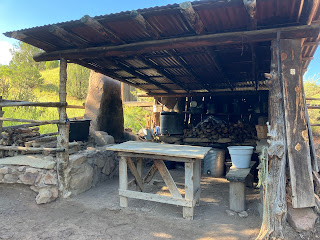
The museum doesn't run the dye shed all the time -- only for certain festivals -- so it was a treat to get to work out there today. Just like the rest of the ranch, it's pretty rustic.
 |
| Lynne Cantwell | 2022 |
We have a number of big pots for the dye, a hearth that fits maybe three big pots, and a cast iron cauldron for a fourth color. Today, we worked with indigo, which makes a deep blue; osage orange, which makes a bright yellow; cochineal, which usually makes a brilliant red, but today we turned out pretty pinks; and in the iron pot, snakeweed, which usually makes yellow, but it reacted with the iron to make a sage green.
How did we get the other colors in my photo above? Overdyeing. You put your yarn in one pot of color, then in one of a different color. For example, the turquoise on the left was dyed yellow first, then overdyed with indigo. The terra cotta colored skeins in the middle were dyed yellow first, then overdyed with our pink cochineal. The teal on the right was a gray heathered yarn (the rest were all white to start with); I put it in the green, then overdyed it with indigo.
Basically, you don't know what you're going to get until to give it a try, which is what makes it so much fun. And if you hate the color you get, you can overdye it and make it a different color.
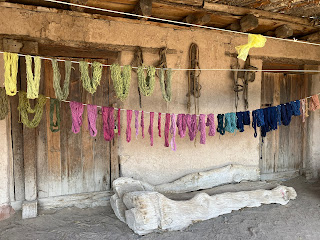
After the yarn is dyed, it's hung up to dry. Then it's rinsed to get any excess dye out and hung up to dry again. There was a class yesterday, too (in the rain, those hardy souls). Here's what our two classes combined did this weekend:
 |
| Lynne Cantwell | 2022 |
We'll use the lighter weight yarn for colcha embroidery and the heavier weight for weaving rugs and things.
There's a lot more to the process, of course, and you can fall down quite the rabbit hole while learning all this stuff. Why, just now, I thought I might add some info here about mordants; I quickly realized the subject could be a reference book, and one I'm not yet qualified to write. So for now, I'm going to wrap up this post. Then I'm going to sit back, relax, and think about something less complicated -- like what I'll do with my new hand-dyed yarn.
***
These moments of colorful blogginess have been brought to you, as a public service, by Lynne Cantwell. Get vaxxed and boosted!


