Showing posts with label diet. Show all posts

Sunday, January 11, 2026

A twofer: The low-carb food pyramid and that ICE video.

I've said it before: some weeks there's nothing to write about, and some weeks there's too much. Like this week. I was all set to opine on the new USDA food pyramid, but then Renee Good was murdered by an ICE agent in Minneapolis. So I'm going to do both -- the food pyramid first, and then the other thing.

***

Screenshot from the USDA website

Never in a million years did I think I would ever agree with the guy with the dead brain worm who's running the US Department of Health and Human Services, under which the US Department of Agriculture sits. But weird shit keeps happening in 2026. So here we are.

I think the new food pyramid is actually okay.

In the 14-plus years I've been blogging (it'll be 15 this August), I've written about weight loss, uh, a whole bunch of times. (There's a search box over on the right; plug in "diet" if you want to find them all.) Most recently, I started eating low carb to get my blood glucose numbers under control. It worked great -- until I went back to work full-time. It became much harder to keep to a low-carb diet, making everything from scratch, when I resumed sitting on my butt for nine hours a day. I still have the treadmill I wrote about a few years back, but (full disclosure) it's currently gathering dust. So I've gained back weight that I lost right after I retired and went low-carb.

But I still believe in low-carb eating: protein at every meal, fruits and veggies but not the starchy ones, full-fat dairy, a limit on whole grains, and no sugar, refined carbs, or junk food. And that's what the new pyramid promotes. 

People are howling about The Fat, particularly that full-fat dairy is now okay. I get that it upends a few decades of nutritional guidance. But there has been scientific evidence over the past few years that the low-fat-dairy advice is mostly circumstantial. That is, nutritionists thought that since fat has more calories than, say, carbs, and that fat is what clogs people's arteries and gives them heart disease, then the answer was to eat less fat. But it turns out that simplistic assumption is wrong. High-fat dairy has been found to improve blood pressure in some studies.

And I believe, just as an anecdotal observation, that it was the advice of nutritionists to eat less fat and consume more carbs back in the '80s that have made obesity and type 2 diabetes become public health concerns.

It wouldn't be the first time that nutrition science has given us bum advice. Remember when eggs were deemed bad for us because of the cholesterol in them? Debunked. Remember when we were told to switch to margarine because of the fat in butter? Also debunked (it turns out the trans fats in margarine are worse than the regular fat in butter).

People are also howling about the advice that added sugar should be kept away from kids until they're eleven years old. Parents are saying it's impossible: "There's sugar in everything!" Well, yes, and it's because food manufacturers have been lacing their products with cheap additives like sugar and salt for decades to make them taste good, and nobody has made them stop. I recognize that it's hard for people who live in food deserts to get fresh fruits and veggies. But cheap food additives and food deserts are things we can fix. (Interestingly, Fox News host Laura Ingraham has admitted that Michelle Obama was right about food deserts. I guess if the advice is coming from a Republican, it's okay?)

Anyway, I find myself applauding the USDA's new food pyramid, and I hope my fellow folks on the left calm down enough to see the wisdom in it. (I can't believe I'm putting Bobby Brainworm and wisdom in the same sentence. This is a really weird year.)

***

Okay, on to the tougher thing to talk about: The murder of Renee Good in Minneapolis this week. Murder is a loaded word, but I believe it's justified in this case.

So many words have been written about this incident already that I'm not going to add much. But I wanted to address the video released by Vice President J.D. Vance this week that the shooter himself, Jonathan Gold, shot with his phone. I haven't watched any of the videos, nor do I intend to; I used to get paid to see tough stuff when I was a journalist, and nobody's paying me to do that anymore. But I read historian Heather Cox Richardson's description of the video on her Substack yesterday. 

I've seen some social media commenters questioning why Vance and other right-wing nutjobs thought the video would help their side. I know exactly why. It's because it shows that a woman -- not Renee, but her wife -- mouthed off to a white man in a position of authority, and she wouldn't stop. So he killed Renee.

That's it. That's their whole justification for the shooting. Woman mouths off and won't stop? Shoot her. Kill her. She deserves it.

Every abuser, ever, has used the same defense. 

I hate this timeline.

***

These moments of bloggy insanity have been brought to you, as a public service, by Lynne Cantwell. #AbolishICE.

Sunday, January 23, 2022

And we're walking.

So I thought I'd post this week about a couple of...oh, let's call them health-related things. 

First: I bought a treadmill. It feels a little like admitting defeat to say that. I mean, the weather here in Santa Fe is about a million times better than it is in DC -- why not just go outside for a walk? Yeah, well, I've been here for about a year and a half now, and going outside for a walk is just not happening on any sort of regular basis. It's partly due to the pandemic; when I lived downtown, going outside was a little scary, what with unmasked tourists of unknown vaccination status wandering around every time I stepped outside my building. But another part of it that I need to have a purpose for a walk. Walk to the library or the post office? Sure. Walk to a museum, or around inside a museum? I'm so there. Take a walk around the block for exercise? I've got better things to do. 

Then, too, as I mentioned last week, the annual legislative session has begun. So for the next month, more or less, I'll be working seven days a week with no breaks during the day. Essentially, I sit at my work computer for nearly every daylight hour.

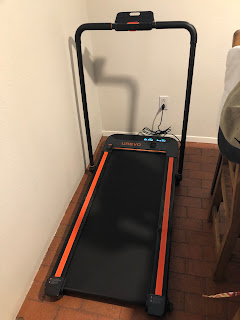
So if I had any hope of getting exercise at all, I knew I needed to get a treadmill. Here's what I got.

Lynne Cantwell 2022
It's a Urevo 2 in 1 under desk treadmill. I don't intend to use it as an under-desk machine, as I don't have a sit-stand desk, but it will definitely work that way. The handle folds flat around the back end of the machine.

This machine has very few bells and whistles. It has no programmed routines and no incline adjustment -- not even a manual one. There's a power switch under the right front edge, and a tiny remote that starts and stops the belt, as well as raising or lowering the speed in .2-mph increments. With the handle in the upright position, there's an additional set of controls: incremental increase and decrease buttons; a pause button; two buttons to bring the speed immediately up to 3 mph and 6 mph, respectively; and a big orange emergency stop button. There's also a tiny ledge for your phone.

For me, the ledge is an excellent feature. I'm not big on watching videos or listening to music or podcasts while I walk, but I do like to read, and my Kindle Paperwhite fits fairly securely on that ledge. (The backrest would fit the Kindle better if it were a little taller, to be honest; I may jury-rig something eventually.)

I hear you, fitness fanatics: "If you can read while you exercise, you're not doing it right!" Yeah, well, pish-tosh. My legs are moving, aren't they? Is this better than sitting on my butt all day or not? That's what I thought. Go away.

Anyway, I've had it for about a week and it's working out great. I'm glad I got it.

The second thing I want to talk about tonight is Noom. You may recall -- although you probably won't -- that I signed up for an app called Noom Coach back in 2017 and told y'all that I'd report back on how it went. Then I never did. Want to know why? Because I didn't lose any weight on it -- or at least none to speak of.

I was reminded of my brief fling with Noom earlier today, when I read a BuzzFeed News story about the app. Like many other things that started out as weight loss programs, Noom now promotes itself as a "health and wellness tool." In the article, they interview the authors of Intuitive Eating, Evelyn Tribole and Elyse Resch. (Intuitive eating was also mentioned in an article in Bon Appetit this month; that one is a fun read about how diet foods have evolved since the 1980s, and I highly recommend it. Although the BuzzFeed article is fun, too. Heck, read 'em both.)

One of Noom's marketing claims is that the program is based on science. It includes a lot of psychological tips and tricks for sticking to the plan, most of which I knew before I started using the app. But at bottom, Noom requires its customers to lose weight by severely restricting calorie intake, just like every other diet. And as Resch told BuzzFeed News: "They’re telling you it could be mind over matter, but it’s not possible. The survival part of the brain is going to do whatever it can to keep you alive... You can learn how to have power over [other habits] but not something that's so physiological and neurochemical. You cannot overcome that unless you're priming yourself for a very serious eating disorder."

One of the biggest dangers with this program -- or really, any weight loss program -- is the emphasis on the number on the scale: if it's not going down, you feel like a failure. Back when I did Weight Watchers (which now calls itself WW because it's about "wellness," doncha know), we were told about ways to track our progress when the scale wouldn't budge (waist circumference and so on). But the weekly weigh-in was a much bigger thing, and it was demoralizing when I hit a plateau. Noom requires a daily weigh-in, which is ridiculous for women -- our weight fluctuates with the time of the month.

Interestingly, Noom is changing tack -- it's marketing to men now. It turns out that men haven't heard all those little tips and tricks that are so ingrained in women's diet culture. But the risk of psychological damage is just as real for men as it is for women. 

Diets don't work, folks. Regardless of whether the purported aim is "health and wellness" or weight loss, you're being set up to fail. 

***

Oh, hey, here's another thing I learned this week: If you're a woman who has hit middle age and you're suddenly struggling with belly fat? Don't make yourself crazy over it. It's a physiological change that hits nearly all of us in the years leading up to menopause, and not only are researchers just now beginning to understand why, they've yet to figure out how to get rid of it. Swell, huh?

***

These moments of walking blogginess have been brought to you, as a public service, by Lynne Cantwell. Get vaxxed! And get some better masks!

Sunday, January 2, 2022

A year of low carbing.

Never fear -- I am not going to turn this into a diet blog, or a dieting blog, or a lifestyle change blog, or any permutation thereof. I don't pretend to be an expert on anything except myself. And I'm not trying to become an influencer, nor am I looking for sponsors.

I also didn't mean to start this post with a disclaimer, but there you have it.

I just wanted to let y'all know about a thing I've been doing for almost a year now. It's a low-carb diet, kinda sorta, and I kinda sorta came up with it myself -- which is to say it's not keto or Atkins or carb counting or any of those. 

If it's anything, it's based on an out-of-print book called The 30-Day Diabetes Cure. The link is to Amazon but don't buy it from them (how often do you hear me say that?) because they're charging a ridiculous amount for it; try Better World Books instead.

Some background: I've had type 2 diabetes for about ten years now. For a long time I was in denial -- mainly because the first thing any doctor will say to you, when you turn up in their office as diabetic or pre-diabetic, is to lose weight. But I'd been dieting since I was eleven years old and had lost hundreds of pounds, only to see them all come back -- and bring friends. At last, I concluded that diets don't work, and that in fact they only serve to line the pockets of the diet and fitness industry. But doctors don't want to hear that. If you tell a doctor that you're not going to go on a diet, they label you as uncooperative -- or worse.

I tried to cooperate -- a little. I went to see a dietitian, who tried to sell me meal-replacement shakes "to jump-start your weight loss." That's a diet, honey, so nope. Later, I saw another dietitian, who tried to get me to track what I was eating and how much and all that stuff. "Does that feel like a diet?" she asked me. Hell, yes, it does, and it's exactly what I swore I'd never do again. She eventually passed me off to another dietitian, who seemed enthusiastic when I mentioned low-carbing (I'd read online that it could work for diabetics - here's a recent study), but of course she wanted me to track my carbs and -- all together now -- THAT'S A DIET.

What I needed was for somebody to tell me which types of foods to stay away from. But nobody wants to do that, and I have a feeling it's because they're in cahoots with the food manufacturers and Big Pharma -- industries that would rather sell you highly processed foods, fake sweeteners, and expensive drugs so new that there are no generics for them. But that's a whole 'nother blog post or three. 

Anyway, this book: A clerk in a vitamin-supplement store here in Santa Fe recommended it to me. "Diabetes is all about what you eat," she said. And I thought, if this book will tell me what to eat to bring my blood sugar down, I'm in. So I ordered a copy and read it. Then, a year ago this week, I started doing it.

For the first ten days, you get no sugar, no alcohol, and no carbs. Most veggies are okay, but no fruits. That's supposed to bring your blood sugar down to normal. Mine was pretty high at the time, even with the super-expensive drugs I was on, so I didn't get to normal in ten days -- but my readings did drop a significant amount. So I kept doing it.

It's been a year, as I said. I've been off the super-expensive drugs for months. My blood sugar is still not quite normal, but it's close. I've lost about 25 pounds and have kept it off, which is huge for me; if I were concentrating on losing weight, I would have given up in frustration months ago.

Here's a funny thing: I'm not interested in sweets or high-carb foods. I suspect it's because I'm not eating them, so there's no craving to trigger. In fact, I can taste hidden sugars in restaurant foods now -- and I don't like them.

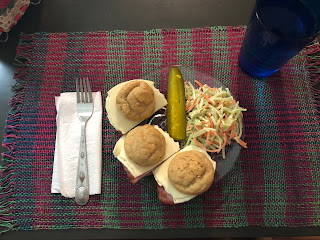
That doesn't mean I'm eating bland meals. Here's my dinner tonight: ham and provolone with brown mustard on almond-flour rolls, broccoli slaw, and a dill pickle spear. 

Lynne Cantwell 2022
The key is to include lots of veggies and make most of your food from scratch. But I'm not a kitchen slave; the broccoli slaw dressing has five ingredients and whipped up in about two minutes, and the slaw itself came in a bag from Trader Joe's.

I'm not saying this will work for everybody. But it makes sense that if eating carbs raises your blood sugar, not eating them will lower it. And I've never had a doctor, or a diabetes educator, or a dietitian flat-out tell me that. I had to find out on my own. 

So now I've told you.

***

These moments of non-dieting blogginess have been brought to you, as a public service, by Lynne Cantwell. Get vaxxed! Wear a mask!

Sunday, March 9, 2014

Curmudgeon Corner: Weight loss for fun and profit. Mostly profit.

-PaulH- via Flickr
Oh, leave me alone, already. Two posts about losing weight in two months hardly constitutes turning this into a dieting blog.

Yes, I'm once again doing the Lifestyle Change Minuet. This makes my 974th attempt, give or take, to get my weight into the "normal" range. I went on my first diet in junior high; I lost 27 lbs. and still wasn't within the normal weight range for my height. (Yes, I still remember the number of pounds I lost on that first diet.) In the decades since, I have tried a number of weight loss programs -- everything from Nutri-System (where they provide you with pre-measured food packets, all of it laced with protein powder, and tell you not to eat any bananas) to Geneen Roth's suggestions (my favorite, which actually is excellent advice: "Eat sitting down in a calm environment. This does not include the car") to counting fat grams under a dietician's care to Weight Watchers. Weight Watchers has been the most successful program for me, in terms of the aggregate number of pounds lost -- I'm up to 100+ lbs. for all the various times I've signed up over the past ten or twelve years, including the 14.6 lbs. I've lost so far this go-round -- so I'm doing it again.

All told over the course of my life, I have lost probably hundreds of pounds -- and I have never, ever reached my goal weight. I don't expect to get there this time, either.

Because here is the thing about weight loss programs: If they worked and kept working, then America wouldn't have a problem with obesity. Everybody would be thin. And then the people in the diet industry would all be out of work. So it's in their best interest to design their programs so that their customers have a little bit of success, and maybe even a lot of success. But the deck is stacked against us for a number of reasons (portion creep among them). So we will always be back.

The Weight Watchers program is one of the best of a bad lot. When you pay your money (and it ain't cheap -- the 17-week Weight Watchers At Work program I'm in cost me $186), they give you a two-digit number. This is the number of points' worth of food you are allowed to eat each day. (Your points-per-day drop as you lose weight; as a friend said jokingly, they punish you for being successful.) You also get access to a website (although depending on your iteration of the program, you may have to pay a monthly fee for the site access) that includes a database of hundreds of thousands of food items. The site includes a place where you can list every bit of food that has gone into your mouth, and it will tell you how many points you've eaten and how many you have left for the day.  You can even type in your personal recipes and the online calculator will tell you how many points there are in each serving. And they have a smartphone app with a barcode reader that's tied to the food database. (This beats the old days, when they handed you a sort of cardboard slide rule and a booklet at your first meeting, and you had to keep track of your food on paper.) They give you some weekly fudge-factor points, and you get extra points if you exercise. But that's the program in a nutshell.

But that's not all there is to Weight Watchers. They also produce cookbooks with point values listed for each recipe, cooking tools designed to help measure portion sizes, and a FitBit-type activity monitor. They also sell food under their brand -- lunch-sized entrees, snack foods in two-point single-serving packets, "ice cream" treats, and so on.

It's the Weight Watchers-branded foods that make me crazy. They are not healthy. The lunch entrees are loaded with salt and chemicals to make up for the lack of fat, the two-point snack foods are jam-packed with artificial sweeteners and other chemical additives, and the "ice cream" ingredients list is mostly unpronounceable.

Sure, the foods appeal to Americans whose palates are used to the chemically-processed sugar/salt/fat American diet. People at my meeting buy boxes of them. But shouldn't Weight Watchers be setting the bar higher? Wouldn't it make more sense for them to sell really healthy foods under their brand? How about Weight Watchers-branded produce? Or fruits sporting "0 points!" Weight Watchers stickers? Because even though they tell you that you can eat anything you want (as long as you count the points), it doesn't take long before you realize that it's really pretty easy to beat the Tyranny of the Points System: you just have to quit eating full-fat dairy and anything fried; cut way back on your consumption of grains, sweets, and alcohol; and load up your plate with fruits and veggies, most of which have zero points.

But, see, if they sold really healthy foods, they wouldn't make as much money. And if people broke their dependence on processed foods, then they wouldn't fall off the wagon as easily, gain back all the weight they lost, and need to join up again.

And yes, even knowing all that, I joined up again.

Stay tuned. I'm sure I'll have more to complain about as the weeks go by.

***
A few bits of business: As promised, the Crosswind e-book edition is now 99 cents; Undertow is on schedule for release March 20th; and I'm busy planning the Facebook virtual beach party in celebration of the launch. Y'all come!

***
These moments of curmudgeonly blogginess have been brought to you, as a public service, by Lynne Cantwell.

Sunday, January 12, 2014

Curmudgeon Corner: a humble bowl of oatmeal.

I swear I'm not going to turn this into a dieting blog.

It's nearly the middle of January, which means your New Year's resolutions -- assuming you made any -- are probably just a distant memory now. But some of us are just now getting going on our, uh, annual goals. One of my annual goals, pretty much every year for the past three or four decades, has been to lose weight. Sometimes it works; sometimes it's an epic fail. This year, it needs to work.

But the photo shows what I'm up against.

When I was in my 20s, I went through a period when I ate oatmeal for breakfast every day. The recipe from the side of the package was 1/3 cup of dry oats (quick-cooking or regular -- we didn't have any of your crappy instant oatmeal product back then, no ma'am) to 2/3 cup of water. I'd cook it on the stove (this was also before microwaves, okay?) and then I dressed the result with a little milk and brown sugar.   I distinctly remember this recipe because I used to keep my 1/3-cup measure inside the oatmeal container so I wouldn't have to hunt it down every morning.

Not long ago, I decided to start eating oatmeal again. Not every day, but a fair amount of the time. It's nutritious (if you don't pour a ton of sugar on it), it takes two minutes in the microwave for the quick-cooking kind, and it's cheap. (I can't believe the price of a box of ready-made cereal today. Five bucks? For processed flour and sugar with selected vitamins put back in? Seriously?)

So okay. I go to make the oatmeal and.... Here, I would like to direct your attention to the photo, which I took tonight. Pay close attention to the line under "Nutrition Facts" -- the one that says, "Serving size."

See that? A serving of oatmeal is now 1/2 cup of dry oats. Then you mix it with a cup of liquid. So the proportions are still the same -- 2 parts liquid to one part oats -- but the amounts have changed. And don't think it's due to the fact that I bought the store brand; the serving size is the same on the package with the guy in the porkpie hat on the front.

A humble bowl of homemade oatmeal has more calories today than it did in 1982.

This upsizing of American eating habits has been going on right under our noses. Dr. David Kessler, the former commissioner of the U.S. Food and Drug Administration, wrote a book called The End of Overeating. In it, he talked about the science behind our food -- not just the nutrition, but the food marketing, too. Food R&D has determined the best ways to convince us to stuff the maximum amount of food down our gullets so that the processed-food conglomerates and fast-food companies can maximize their profits. It's no accident that processed foods are high in sugar, fat and salt, or that they're often sold in bite-sized pieces (chicken nuggets, popcorn shrimp, etc.) or in slurpable packaging (Go-gurt, anyone?). All of it is deliberate. After all, chewing takes time. Delicate flavors encourage people to slow down and savor their food. It's far better, from the manufacturers' point of view, to have us scarfing marginally tasty food that doesn't really fill us up, but that we can eat as quickly as possible -- way before our stomachs can signal to our brains that we're full -- so that we'll eat more. Because the more we eat, the more money they make.

I think It's pretty well known that restaurants do this -- and I'm not just talking about McDonald's. Any standard menu item in most mid-priced American restaurants will give you two, or maybe even three, actual serving-size servings. So people are on guard when they go out to eat, at least to some extent.

But come on -- oatmeal?

America has a huge obesity problem today. Gee, I wonder why.

Wish me luck, guys.

***
Now that I've got that rant out of my system....

Undertow has gone to my editor (whoo hoo!), which means we're on track for an early spring release. (That also means I need to come up with a plot for Scorched Earth here pretty quick. But I digress.)

The Crosswind tour is underway, and I'm having a blast. The stops are listed under the "Tour Dates" tab up top. Please come by! And be sure to enter the contest -- you could win one of two autographed paperbacks, a Navajo dream pillow, or a $10 Amazon gift card. I've got to give 'em to somebody. Might as well be you.

***
This moment of bloggy oatmeal has been brought to you, as a public service, by Lynne Cantwell.