Showing posts with label Edward R. Murrow. Show all posts

Sunday, October 23, 2022

The problem might be in your TV, after all.

Here's that serious post that I was going to write last week but ran out of mojo. And in it, I'm going to admit that I was wrong.

maxxyustas | Deposit Photos

For the past six plus years, I've been banging the drum about how serious journalists shouldn't take sides. Report on all sides of the story, I've been saying, and let the audience sort it out. It worked for Edward R. Murrow, I said -- he reported dispassionately on Sen. Joseph McCarthy, simply showing him in all his Red-baiting glory and allowing his viewers to draw their own conclusions. When McCarthy realized Murrow was on to him, he targeted the journalist, as I noted in another post: "[T]he senator got mad at Murrow and accused him of being a Communist himself. Why didn't Murrow call him out as a liar? Because in attacking Murrow, McCarthy showed his true colors. Murrow didn't do editorials. He was a journalist. His method was to give McCarthy just enough rope to hang himself." It worked. Public opinion soon turned against McCarthy -- not before ruining a lot of lives, particularly in Hollywood, but it did turn.

I learned about Murrow and his role in bringing down McCarthy in journalism school in the 1970s. Journalism, we were taught, had a critical First Amendment role; it was the marketplace of ideas, where all sides aired their views. The lesson we journalism students took away from the Army-McCarthy hearings, as well as from the Pentagon Papers and Watergate, was that if journalists did their job and presented all sides objectively, people would figure things out on their own

I believed it. For decades, I believed it. I don't believe it anymore.

Margaret Sullivan served for many years as media columnist for the Washington Post. Her job involved critiquing the way the news media, including her own paper, covered the stories of the day, and in many cases how they could have done it better. She has a book coming out this fall -- a sort of memoir of her decades in the newspaper business. And in a piece in the Washington Post Magazine last weekend, she wrote about how the Trump presidency changed her view of how journalists should cover him. For many decades, she too believed in traditional journalism and the marketplace of ideas. But now she writes: "As [former President] Trump prepares to run again in 2024, it’s worth reminding ourselves of the lessons we’ve learned — and committing to the principle that, when covering politicians who are essentially running against democracy, old-style journalism will no longer suffice."

Journalists can no longer simply repeat what newsmakers say. Discernment was always part of the job -- if the sales manager asked you to do a story about his big account, you didn't do it unless there was an actual news angle. But at certain levels, particularly in day-to-day political reporting, the idea was to tell people what the guy said, and then tell what his opponent said, and your responsibility pretty much ended there. 

As Sullivan says -- heck, as we've all seen -- Trump saw how it worked and capitalized on it. He spewed endless bilge, and news managers covered every second of it because his bilge drew eyeballs for their advertisers. Journalists should have called him on his bullshit a lot sooner than they did. Even now, six years down the road, I see too many euphemisms in stories about the guy. Baseless claims. False this or that. Why don't they just come right out and say he's lying? 

I suppose one reason is that news organizations are skittish about being sued for libel. But another thing I learned in journalism school is that the first defense against a charge of libel is the truth. The lies Trump and his minions tell have been disproven many, many times over. It's clear they're lies -- not falsehoods or baseless whatevers.

Moreover, it's not like Trump didn't know the 2020 election results were legit. Many of his advisors told him so. So did members of his family. He even admitted it in private. And yet he has continued to lie in public that the election was stolen from him. Maybe it was because he didn't want to think of himself as a loser. Maybe he wanted to keep the grift going so his supporters would continue to send him money. Maybe both, and more.

Sullivan's point is that if Trump runs again, things have to be different: "I’m convinced that journalists — specifically those who cover politics — must keep a sharp focus on truth-seeking, not old-style performative neutrality. Does that mean we throw objectivity out the window? Of course not. We should be resolutely objective in the sense of seeking evidence and approaching subjects with an open mind. We should not, however, resort to taking everything down the middle, no matter what." Simply handing  each side a microphone isn't going to be enough: "We should be thinking about what coverage serves the public best."

She also criticizes traditional political coverage -- reports on the latest polls, stories based on "conventional wisdom", "campaign in disarray" articles, and the like -- as a distraction from the bigger picture that a chunk of one of our political parties seeks to end democracy.

That doesn't mean playing favorites or going soft on the other party, she says. What's required is for journalists to make a habit of putting their reporting in context: "They shouldn’t just repeat what’s being said, but help explain what it means."

Another thing I learned in journalism school is that every news story should answer six questions -- the famous five Ws and an H: who, what, when, where, why, and how. It's the why that Sullivan is addressing here: We need not just the facts, but the truth, in context. Trump and his supporters will howl about the unfairness of it all -- but they'll howl regardless. Journalists must do it anyway. Our democracy is on the line.

***

These moments of bloggy truthiness have been brought to you, as a public service, by Lynne Cantwell. Stay safe! And get out and vote!

Sunday, July 29, 2018

The Fourth Estate.

So there's this phone app called HQ. It's a daily online quiz where they give away real cash money if you can correctly answer a bunch of multiple-choice trivia questions. The kids got me into it, and for a while we were playing every day. Sometimes the questions are easy for them because they're young; sometimes they're easy for me because I'm not so young.

Anyway, one day, one of the questions was something along the lines of, "What is the Fourth Estate?" Easy peasy for me -- it's journalism. The kids told me later that they'd never heard of the term before. That's when I realized I'd never heard it until I went to journalism school.

Just in case you've never been to journalism school, I will explain: The news media are the fourth check-and-balance on the U.S. system of government. The other three "estates" are the three branches of government you're familiar with from civics or history class: executive, legislative, and judicial. Journalists are not part of the government -- and that's what makes them so valuable. Being outside the system, they can report objectively about what's going on inside the system; they don't have to keep anybody in any branch of government happy in order to keep their jobs.

With me so far? Okay. That brings us to this meme, which I have seen in a couple of different forms recently on Facebook:


I agree with the spirit behind the quote, but I'm not sure I agree with all of its implications. Because it is, in fact, the journalist's job to quote them both -- and if someone says it's not rain, but drizzle, they should be quoted, too. All sides should be presented. It's the news consumer's job to figure out which one is true.

I've talked about this before on the blog, in connection with the Keystone XL pipeline. In that post, I mentioned Edward R. Murrow, who went up against Sen. Joe McCarthy of Minnesota, a demagogue who pursued a personal vendetta to ruin everyone he didn't like by claiming they were Communists. Murrow devoted several episodes of his news show to McCarthy, explaining his methods objectively. He didn't hurl invectives or call Sen. McCarthy a liar; he simply showed his viewers what was going on and allowed them to draw their own conclusions.

Once the shows aired, Murrow had reason to attack McCarthy; the senator got mad at Murrow and accused him of being a Communist himself. Why didn't Murrow call him out as a liar? Because in attacking Murrow, McCarthy showed his true colors. Murrow didn't do editorials. He was a journalist. His method was to give McCarthy just enough rope to hang himself.

The framers of the Constitution realized how important a free press would be to our nation; that's why the First Amendment guarantees us freedom of speech and of the press. But for the Fourth Estate to do its job most effectively, news consumers have to be aware of all sides of the issue. They cannot be expected to decide what's true when presented with just one side of the story. They definitely cannot be expected to know what's true when they're constantly being told that the journalists at major news outlets -- people who believe strongly in their role as part of the Fourth Estate -- are purveyors of fake news and enemies of the people.

On July 20th, New York Times publisher A.G. Sulzberger met with President Trump at the White House. The meeting was supposed to be off the record, but the President tweeted about it this weekend anyway. Trump said the discussion centered on "the vast amounts of Fake News being put out by the media."

That prompted Sulzberger to break his silence. In his statement, he said, "I told the president directly that I thought that his language was not just divisive but increasingly dangerous." And he said, "I warned that this inflammatory language is contributing to a rise in threats against journalists and will lead to violence." (You may recall that five people were killed in a mass shooting at the Capital Gazette in Annapolis, MD, last month. Police say the shooter didn't like something the paper had published about him.)

President Trump doesn't appear to care. In a speech last week to veterans, he told them, "Just remember: what you're seeing and what you're reading is not what's happening." Don't believe the journalists, in other words; believe only me.

I've talked about gaslighting on the blog before, too. You may recall I said that the gaslighter's ultimate aim is to convince his victim that the only person telling the truth is the gaslighter.

Feel free to draw your own conclusions.

***
These moments of Fourth Estate blogginess have been brought to you, as a public service, by Lynne Cantwell.

Sunday, December 4, 2016

Good journalism requires audience participation.

Opponents of the Dakota Access Pipeline received good news today. The U.S. Department of the Army announced it was denying the permit to build the section of pipeline that would have crossed the Missouri River near the Standing Rock Sioux reservation in North Dakota. The fight isn't over, but still, this is a huge win for the thousands of Native people, and their allies, who have opposed the project.

This story has been covered much more thoroughly on social media than by mainstream media, for a number of reasons. For starters, news organizations have been doing more with less for at least twenty years. One of the reasons I got out of the news business in 1998 was that I was tired of getting laid off every couple of years. News organizations kept consolidating, cutting personnel and even whole bureaus, in an effort to make more money for shareholders. And so here we are today: There aren't enough bodies left to cover everything that deserves to be covered. If you've wondered why Donald Trump's Twitter rants get more attention than the Dakota Access Pipeline, that's the reason. It's much cheaper to have an intern sit in an office and monitor Twitter than it is to send a microwave truck, an engineer, a producer, a camera operator and a reporter to the back end of nowhere to take pictures of Indians dancing in front of cops in riot gear.

I'm not denigrating the water protectors; I'm on their side. What I'm trying to do is explain what goes through news executives' minds when they decide what to spend their scarce resources on. Trump's Twitter feed = guaranteed story. Sending a crew to North Dakota for weeks in hopes of "war" footage, not so much.

So it didn't surprise me that CNN, et al., didn't start sending crews to the Oceti Sakowin camp until last week. It was clear things were coming to a head: The Army Corps of Engineers had announced the "protesters" needed to move, the governor of North Dakota was threatening to send in troops to clear the area (although he said later that was just a misunderstanding), and a cadre of volunteer veterans was due to arrive.

As soon as pictures began showing up on the networks, people could see that something was off. The sheriff of Morton County, ND, kept saying that his officers felt threatened by the Sioux, but the photos and videos from the site showed armor-plated police vehicles looming over unarmed people praying. 

More than one person has criticized those media reports, saying the journalists weren't doing their jobs.

Well, actually, they were.

Bear with me while I digress. In 1954, a U.S. senator named Joseph McCarthy made a name for himself by accusing anyone he didn't like of being a Communist. First, he claimed more than 200 Communists had infiltrated the State Department -- a claim he couldn't substantiate. Nevertheless, he was awarded the chairmanship of the Senate Committee on Government Operations in 1952, and used it as a bully pulpit to ruin hundreds of people, including many working in the film industry.

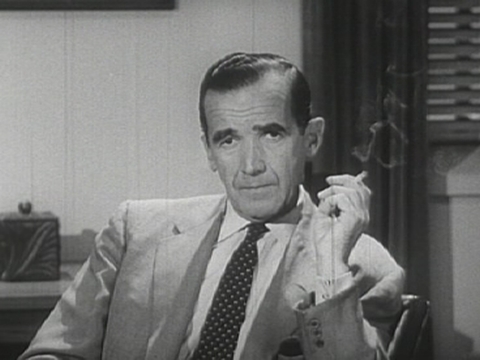
Edward R. Murrow | Wikipedia (Public Domain)
Television was his downfall. In March 1954, Edward R. Murrow devoted an entire episode of "See It Now" to McCarthy, eviscerating the senator by showing his methods in detail. Predictably, McCarthy attacked Murrow, accusing him of being a Communist -- a charge Murrow easily refuted. (George Clooney directed a terrific movie about Murrow's battle with McCarthy called "Good Night and Good Luck".) Shortly thereafter, an attorney named Joe Welch took on McCarthy in his own committee chamber, asking him on live television, "Have you no sense of decency, sir?" At that point, McCarthy's name was mud. 

What the big-name news organizations at the Oceti Sakowin camp have been doing for the past few days is exactly the same thing Murrow did to McCarthy: they've given the cops just enough rope to hang themselves with. 

Journalists are supposed to report on all sides of an issue. The sheriff's statements were news; so were the protests. But it was no accident that reporters were reading the sheriff's inflammatory words over video of what was actually happening at the camp. As news consumers, we're supposed to make the connection ourselves.

***
These moments of newsy blogginess have been brought to you, as a public service, by Lynne Cantwell.