Showing posts with label Brighid. Show all posts

Sunday, February 1, 2026

It's Brigid's Day; and how kids learn racism.

Several years' worth of Brigid's crosses. 
Lynne Cantwell | 2025
Blessed Imbolc! Today is the first day of spring in Ireland, and it's one of those Pagan sabbats where Americans wonder why folks in the UK are rushing the seasons. Because it's still definitely winter here, no matter what that Pennsylvania groundhog will say tomorrow; my daughters still haven't finished digging their car out from under the freakish ice storm that DC experienced last week. But the daylight hours are perceptibly lengthening, and within a few weeks, spring will be here for us, too.

Imbolc is the day to celebrate Brigid, the Irish goddess of poetry, healing and smithcraft. (It's also a day to honor the Christian saint of the same name, but I'm talking about Paganism here.) I saw a post on Facebook over the past couple of days in which the author tried to argue that Brigid was also a goddess of conflict. Don't bother asking Google's A.I. -- you'll get the usual conflation of Brigid the Irish goddess with both St. Brigid and Brigantia, a goddess of Celtic Britain who's also linked to Boudica, a queen of Icenic tribe who managed to hold off the Romans for a while in CE 61 or so. Maybe that's where the idea originates of a link between Brigid and conflict.

But Brigid is not the Morrigan. Hers is instead the gentler art of conflict resolution -- of poetry and healing, and of lamenting the dead (she's credited with inventing keening). If She carries a hammer, it's because She uses it at Her forge. Making weaponry is not the same as wielding it. And iron can be shaped into more than just swords.

That's my experience of it, anyway.

***

I guess you could say that conflict is a theme of both halves of this post.

Earlier today, I read a remembrance by someone who's about my age. She said that when she was in elementary school, she made friends with another girl and invited her home one day -- and her mother ordered the friend to leave, then beat the crap out of the daughter because the friend was Black and she'd brought her into their house and don't ever do that again.

Which reminded me of a similar incident in my own childhood. Although mine was, thankfully, less violent.

This would have been in the mid to late '60s. Our neighborhood was white, but there were some houses along the railroad tracks where some Black families lived. Of course we all went to school together (and our neighborhood got shifted from one elementary school to another, depending on which school needed more Black kids that year, but I digress). I knew the kids by sight -- we all rode the same bus, after all -- although I didn't hang around with them. 

One day, one of the little Black girls ventured into our neighborhood. We ended up playing together in my yard, and at one point we decided to go inside. And my mother threw a fit. She told the girl to leave and told me I was never to bring any Black kids home again, ever.

Well, she didn't use the word "Black". This was the '60s, after all.

Anyway, the girl was nice, and I didn't understand what the color of her skin had to do with anything. I was too young then to give voice to my thoughts, and of course I was a good girl and obeyed my parents. But my belief that we are all human, and therefore worthy of respect, may have been born that day.

The hell of it is that my father had built our house with help from my uncle John, who was a carpenter, and Mr. Farmer, a Black man who lived in one of those houses along the railroad tracks.

A Black man was good enough to build our house, but a little Black girl couldn't be allowed inside to play? How crazy is that?

***

Later on, when my own kids went to school and learned about Black History Month, they practically yelled at me: "Why didn't you tell us any of this?"

What, that Black folks were different from white folks? It never occurred to me. When I was a kid, I'd learned that "different" meant bad. I thought the idea was to treat everybody the same, because we are all the same. We're all human beings. 

That's what equality means to me still. I want to learn about our differences, sure, but I want to celebrate them. I want to honor everyone's stories and all the heroes from every culture. I want us all to be proud of each other.

Pie in the sky? Maybe so. But we can't get there if we don't dream it first.

***

These moments of bloggy conflict resolution have been brought to you, as a public service, by Lynne Cantwell. Blessed Imbolc and happy Black History Month, too.

Sunday, January 29, 2023

We're nearly halfway to the light.


Lynne Cantwell 2023
Alert hearth/myth readers know about my penchant for liminal times and liminal spaces -- those borderlands between this day and the next or this place and another. A lot of my stories take place in a liminal space of one sort or another.

I thought you'd be glad to know that we're creeping up on one of these transition times. On Imbolc -- which some know as Candlemas and most know as Groundhog Day -- we'll be halfway from the winter solstice to the spring equinox. In other words, my friends, spring is on its way.

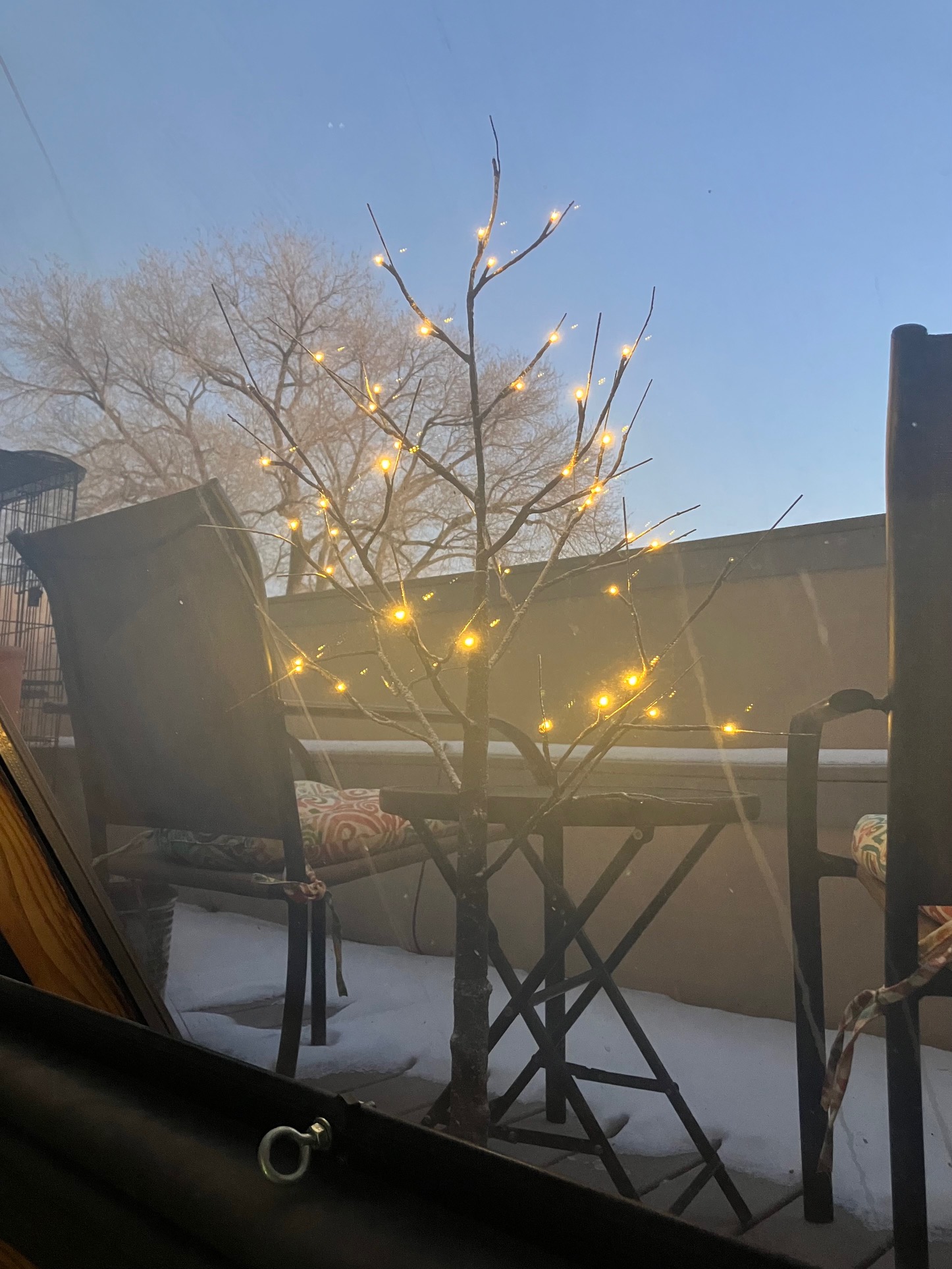
I attended an online class about Imbolc this week. The hosts asked the participants whether they'd seen any signs that spring is coming. Some folks talked about seeing plants beginning to green up. I don't know where those folks live, but it ain't here in Santa Fe -- my porch still looks like this photo that I took near sunset a few days ago.

That little tree is the fake birch tree I mentioned in October.  It's supposed to be winter holiday decor, but I've been keeping it up longer and longer every year. Last year, I left it up on the porch through Imbolc -- and maybe even another week or so, through the end of the state legislature's annual session. Last year, we had a 30-day session. This year, we're doing a 60-day session (in New Mexico, the legislature alternates between 30- and 60-day sessions), and I may just leave the tree up until it's over on March 18th. That's just a couple of days before Ostara, a.k.a. the spring equinox, on March 20th.

Working the session is like living in liminal time for two solid months. Have I explained about this before? We work seven days a week, with slightly shorter hours on Saturdays and a half day off on Sundays. (Yes, it's legal. State legislatures are exempt from federal wage and hour laws -- I looked it up.)  For me, it's a little like going into a trance the weekend before Martin Luther King Day and waking up when spring has sprung. There is not much time to buy groceries and clean out Tigs's litter box, let alone have a life. So a little twinkling beacon of hope to light the darkness isn't such a bad thing.

And lighting the darkness is appropriate for Imbolc, one of Paganism's fire festivals. As I've mentioned before, Brigid was a goddess long before the Catholic church appropriated her as a saint, and over the years since, goddess and saint have become conflated. On the grounds of the cathedral in Kildare in Ireland, you can visit the foundation of Brigid's fire temple, and just down the lane is Solas Bhríde, where the Brigidine sisters have kept St. Brigid's perpetual flame burning since 1993. I received a very warm welcome there when I visited Kildare several years ago. I recommend a stop, if you're ever in the area.

Lynne Cantwell 2016
A little further on from Solas Bhríde is this lovely shrine to Brigid, together with one of the many wells throughout Ireland that are dedicated to her.

This Imbolc is a big deal. It's the first time ever that St. Brigid's Day (in Irish: Lá Fhéile Bríde) will be observed as a national holiday in Ireland. The official day is February 1st, although the bank holiday will be Monday, February 6th (the Irish, like Americans, prefer to schedule their holidays near a weekend. Why not Friday the 3rd, then? Go ask the Irish government). According to the Solas Bhríde website, the centre will be hosting a bunch of events throughout the weekend, including a ramble on the Curragh

What is the Curragh, you ask? Well, thereby hangs a tale

Back in ancient times, the goddess Brigid (or maybe it was St. Brigid) petitioned the King of Leinster for a bit of land to build a monastery for herself and her followers. The king laughed and said no -- he needed all of his land for himself. Then Brigid made him an offer: what if he gave her just the land she could cover with her cloak? The king laughed again and agreed. And so Brigid and her followers set to unfurling her cloak -- which of course was magical (or miraculous, if you prefer). Before they were done, they'd covered 5,000 acres of pastureland near Kildare. The king realized he'd been had, but he stuck to his word. The Curragh belonged to Brigid.

Today, it's owned by the government of Ireland. There's a famous horse breeding facility and racecourse on the outskirts, and a military camp on the grounds. The big battle scene in the movie Braveheart was shot on the Curragh.

Anyway, here in America, there's no holiday for Brigid, so I will be working on Imbolc. But I'll keep my tree lit for her -- and I'll be grateful that we're halfway to spring.

***

These moments of magical blogginess have been brought to you, as a public service, by Lynne Cantwell. Hail, Brigid!

Sunday, February 20, 2022

My Pagan path in an elevator pitch.

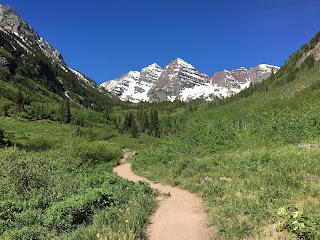
Maroon Bells | Lynne Cantwell 2017

I got name-checked on the Patheos blog of a Druid priest this week.

I've mentioned John Beckett here before. I've occasionally used one or another of his posts as a springboard for a blog post of my own. I've also taken some of the online classes he has offered; I'm not a Druid, but his classes are all ecumenical, if I may repurpose the term to mean practices and beliefs that are common to all varieties of Pagans. I did my best to enumerate the types of Pagans in a blog post a few years ago. 

But I still get questions about what Paganism is. A lot of them come from folks who have quit one or another Christian sect (I seem to have collected a number of ex-Mormon friends) and made a 180-degree turn into atheism. As if there are only the two choices: believe in Jehovah or believe in nothing.

So I asked John how to talk to these friends about Paganism -- keeping in mind that Pagans don't proselytize (no, really -- we don't). His answer is in the post that I linked to up top.

He calls these types of folks "religiously ignorant." I think that's a little harsh -- I'd go for "religiously uninformed" -- but his blog isn't mine. Regardless, the point is that because of the ubiquity of Christianity in the West, for the vast majority of folks, that's their only religious reference. So, as he says, first people want to know what you believe, and second, they want to know what your holy book is. Alert hearth/myth readers will see the problem immediately: Paganism has no holy book and no single set of beliefs. 

The next thing they often want to know is what you have to do to keep from going to Hell. When you say Pagans don't have a Hell, it doesn't compute. Pagans strive to live morally, of course, but not because of some heavenly reward awaiting us. The reward is here, in this life.

I encourage you to read John's post for his overview. If you're looking for more in-depth info, I could recommend a book or two. But if you want to know what I believe? Well, I guess I'd better write an elevator pitch for you. Here goes:

I believe there are a whole lot of gods. I've spoken in meditation with several of them, and I am confident that they are separate persons -- neither facets of a single overarching deity nor figments of my imagination. I have relationships with a few gods, and if you've read any of the Pipe Woman Chronicles, their names may be familiar to you: Lugh, who can do anything; Brighid, blacksmith, healer, and poet; Morrigan, both a warrior and the personification of the land; and Mokosh, the Slavs' Mother Earth, who spins the thread of life.  

I believe in animism: that not just humans, but everything on this planet, is a person who deserves respect. I believe that none of these persons is more special than the other -- which is to say that humanity has no special, elevated place on this earth. Our job is to learn to coexist, not just with each other but also with animals, with plants, with the air and the water, and yes, even with the rocks. 

I believe that magic is a thing, and that it works. I've seen it work.

I believe that to believe in Hell is to live in fear. I look forward to going to the Summerlands when I die, and I know I don't have to believe a specific thing or live in a particular way to get there -- the Summerlands are open to all.

I'm happy with this path. It feels right to me. It makes my life richer. It makes it make sense.

If you've chosen a different path and you're happy with it, that's awesome. I would suggest, though, that you ask yourself how you found your path. If it's simply a wholesale rejection of the path you grew up following, then consider whether your former path is still controlling you. If that's your jam, then great. If not -- well. Maybe shop around for one that has no relation at all to the one you rejected.

***

The legislative session ended at noon on Thursday -- right on time. I've been cocooning since then (other than a trip to the grocery store), readjusting to being retired, and I'm just about ready to rejoin the world. 

So I'm taking a break from the blog next week. See you back here in two weeks. Might have some new  pictures for you then.

***

These moments of bloggy pathfinding have been brought to you, as a public service, by Lynne Cantwell. Get vaxxed!

Sunday, February 2, 2020

Imbolc is upon us.

While y'all are busy with your sportsball game (I'm rooting for the team in red*), I'll return to a topic that I've written about a couple of times before: the Pagan sabbat of Imbolc.

You may have seen some stuff on Facebook that yesterday was the day. And so it is, I guess, in Ireland, where the whole thing started. And the Catholic Church celebrates St. Brighid's Day on February 1st. But I'd always thought the Pagan holiday was the 2nd.

By definition, Imbolc is the day halfway between the winter solstice, otherwise known as Yule, and the spring equinox, or Ostara. It turns out that if you're calculating the exact midpoint between the astronomical winter solstice and the astronomical spring equinox, the midpoint can be anywhere from February 2nd through the 7th. Last year, according to this website, it fell on February 4th in the UK; this site has an interactive chart that shows Imbolc was on the 3rd last year in North America and on the 4th this year.

We Americans like to keep the dates of our holidays simple, though -- which is why, long ago, we moved every public holiday we could to a Monday. So let's just pick a day, shall we? I'm calling it Imbolc today.

Spring, by Giuseppe Arcimboldo | Wikimedia Commons
Another oddity: In Ireland, Imbolc is considered the first day of astronomical spring. Ireland's weather benefits from warm ocean currents that bring a lot of rain (and here we all thought Ireland was so green by the grace of God) but also mostly mild temperatures. So while a lot of North Americans are usually shivering in our boots and parkas in early February, in Ireland the snowdrops have begun to bloom and the ewes are pregnant and getting ready to give birth. The modern name for Imbolc derives from the Irish word imbolg, which means "in the belly."

That gives me a natural segue to Brighid -- who, after her saintly remodeling, was said to be the midwife at the birth of Jesus. As amazing (and very likely untrue) as that is, the Irish pagan goddess was pretty amazing in her own right. Goddess of medicine she was, and of poets, and of smithcraft. And like the Greek goddess Hecate, Brighid is also a goddess of crossroads.

I was thinking earlier this week about how well all those things fit together. When you get right down to it, they are all creative paths. Smiths use fire to transform raw metals into useful and beautiful things. Poets and writers use the "fire in the belly" to fuel their creative endeavors. And midwives ease the births of new humans, each possessing their own spark of life.

Are you sensing a theme here? Have I mentioned that Brighid is a fire goddess?

I'm honestly not sure how the crossroads thing works into the legend. But if you're at a crossroads in your life, you can ask Brighid in meditation for help in deciding which way to go. I've done this a few times over the years and I can tell you it works.

Blessed Imbolc, everyone.

*(Both teams this year have red uniforms. It's a joke, people.)

***
I've been pretty fired up lately over making new covers for the Elemental Keys series. The books will all have new titles, too. I'm hoping Amazon will let me keep the series title, but we'll see how that goes. In any case, stay tuned for the relaunch and the release of Book 4!

***
These moments of fiery blogginess have been brought to you, as a public service, by Lynne Cantwell.

Sunday, February 1, 2015

Brigid at the Crossroads.

It's become something of a tradition here at hearth/myth to do an Imbolc post. A quick recap: Imbolc is the halfway point between the winter solstice and the spring equinox. It's known as Candlemas to Christians, and as Groundhog Day to most Americans. (As my dad used to say, "If the groundhog sees his shadow, we'll have six more weeks of winter. If he doesn't see his shadow, we'll have another month and a half!" Yeah, thanks, Dad. I'll make a note.)

For Pagans, Imbolc honors Brighid, the Irish goddess of spinning and weaving, smithcraft, and poetry. But she's also sometimes called a goddess of the crossroads. I have occasionally wondered where the association came from, so I committed a little Google-fu tonight to see what I could scope out.

If you do a search for "crossroads goddess," the first name that will pop up -- in a big box, no less -- is Hecate. She's considered to be a Greek goddess, although the Greeks probably adopted Her from somewhere else. She was originally considered to be a beautiful young woman, and was associated with abundance. By the time the Romans got hold of Her, She had morphed into a crone, the goddess of the dead. Even in Greece, She had aged, and had picked up an association with the underworld; Hecate is the one who led Demeter there to find her daughter Persephone, after Hades had carried her off.

Hecate was specifically in charge of the kind of intersection where three roads meet. This is not necessarily a good thing. In the old days, criminals and people who committed suicide were buried at a crossroads, and people thought these intersections were haunted.

As I said earlier, Brighid too is sometimes considered to be a goddess of the crossroads -- but nobody's ever put Her in charge of the underworld, or suggested She is anything but good. The Catholic Church even made her a saint. So where did this association come from?

St. Brigid's Cross - Wikimedia CommonsFrom what I can tell, it has to do with the Brighid's Cross. It's traditionally woven of reeds or rushes on Imbolc, and hung above the front door of the house as a blessing. (Reeds and rushes are hard to find in my part of the world, so chenille stems, which we called pipe cleaners when I was a kid, are my media of choice.) It's said St. Brigid wove the first one while she comforted a dying Irish chieftain; when he heard her explanation of the significance of the cross, he converted to Christianity. But Brighid's Cross predates Christianity in Ireland. And some say the design symbolizes the Four Provinces of Ireland, with Brighid Herself at the center.

Interestingly, there's apparently a tradition in which Hecate is said to pass a torch to Brighid on January 31st, the eve of Imbolc -- the implication being that Hecate rules the dark half of the year, and Brighid rules the light half. I guess that would mean that Brighid gives the torch back to Hecate on the eve of Lughnasa? Or extinguishes it then? I don't know. If you're familiar with this tradition, please let me know in the comments. I'd be grateful.

If you're interested in making your own Brighid's Cross, I found these directions online. It requires either 12 or 16 pieces of straw, and they need to be flexible enough to bend without breaking, so you need to either pick them fresh or soak them. (I am not good at advance planning for this sort of thing, which is why I always use pipe cleaners. Plus then you can make each arm of your cross a different color.) You could also make a three-armed cross (there's that Y-intersection again...), with either 9 or 12 pieces of straw; the construction principle is the same.

And you can incorporate the construction of your Brighid's Cross into a divination or ritual. The idea is to ask Brighid to help you figure out the direction your life should take for the next year. Here's one from the Llewellyn Encyclopedia, and another from paganwiccan.about.com. I've used the one from About.com before and I liked it a lot. Everybody's different, of course. But if you're finding yourself at a crossroads these days, talking to Brighid could be one more way to help you make a decision.

Happy Imbolc!

***
You may be interested to know that my writing future has been mapped out for at least the next few months. I'm almost 20,000 words into the first book of Sage's story as we speak. I'm still dithering over the title, but as soon as I figure it out, I'll let y'all know.

In other news, "The Door into Summer" has been picked up for the inaugural issue of Five59 Monthly. You can read the whole issue online for free at the link. I'm told there will be a way to download a copy for your e-reader here shortly. As soon as I find out the specifics, I'll let y'all know.

***
This bloggy crossroad has been brought to you, as a public service, by Lynne Cantwell.

Sunday, February 2, 2014

Imbolc and the power of older women.

The Wheel of the Year keeps turning, and so here we are at Imbolc again. I talked about some of the folklore about Imbolc last year, and some fun facts about Brighid the year before. This year, I'd like to talk a little bit more about Brighid and what She may mean to us women writers of a certain age.

Wicca loves its Triple Goddesses -- typically Maiden, Mother, and Crone -- and it tends to cast as many goddesses as it can into that mold. Brighid got the treatment early on. She's considered to be the goddess of poets, childbirth, and metalsmiths, so hey, there's your three-in-one, right? That makes Her a triple goddess, right?

Lots of people think so, but I don't necessarily agree. Mortal women are multi-talented, after all. Why can't a goddess be the patron (matron?) of multiple disciplines without somebody suggesting She should be split into multiple beings? Especially when gods don't get the same treatment. Lugh's good at everything -- He, too, is a patron of poets, among other things -- but I've never heard anybody suggest He should be called a Bazillion-fold God.

Anyway. The point is Brighid wears multiple hats and is backed by a wealth of experience. That's what makes Her so easy to relate to, in my opinion; She's so much like us mere mortal women in that way, particularly as we get older and have more, and more varied, experiences under our belts. It makes perfect sense to me that a single goddess could raise a child while at the same time writing interesting prose and hammering out practical, tangible objects -- because here on Earth, women do it every day.

Yet often, we don't get credit for all we do -- particularly once we hit middle age. Too many times, still, only young, attractive women get any attention. Fay Weldon wrote a piece for the New York Times this week in which she talks about how writers are still advised not to write stories featuring women in their 50s. Sure, the bulk of the book-buying public is made up of those women, but the conventional wisdom is that they -- we -- don't want to read about ourselves as we are.
[T]hey like to identify with themselves when young and beautiful, when sexual power and adventures were for the taking and life was fun — not as they are now, with bulging hips and crepey necks. Why wouldn’t they?
Really? Maybe I'm an outlier in this, as I am in much of the rest of popular culture. But personally, I'm pretty tired of reading about teen and twentysomething protagonists who are just figuring out their way in the world. That's why Naomi was in her mid-30s in the Pipe Woman Chronicles, and why Tess and Sue in Land, Sea, Sky are close to 30. I think women who have seen something of life are much more interesting to read about -- and to write about, too.

Huh. It just occurred to me that when I get around to telling Sage's story, Naomi will be in her mid-50s and Joseph will be pushing 60. I knew they'd be an old married couple, but...huh.

Anyway, Weldon goes on to offer hope to middle-aged women writers: once you push through to 80, she says, the publishing establishment will be interested in you again: "so old as to seem ageless, sexless as a sage." Sounds appealing, doesn't it? In the meantime, she advises us women of a certain age to consider going indie:
Meanwhile the female writer still going through the doldrums of middle age should look at the advent of the e-book as a blessing. It is such an anonymous medium. The writer can be from anywhere and as old or young as she likes. The quality of the text emerges without frills, without the photo on the back of the book. And, should you e-publish yourself, with any luck a “proper” publisher, impressed by your skill and panache, will turn it into a book as we once knew it, indifferent to your age.
I think her last sentence is a little out of touch; "proper" publishers today are flailing, and "a book as we once knew it" doesn't really happen any more. But as for indie publishing being a blessing for women of a certain age? With that, I heartily agree.

***
Undertow is back from my editor -- huzzah! We're on track for publication in mid-March or so. I'll send a newsletter update pretty soon.

Also, the Indies Unlimited 2013 Flash Fiction Anthology is available now, and I've got a piece in it again this year. And there's been some discussion amongst my BookGoodies pals about doing another anthology -- this one geared toward summer. Stay tuned for more info on that.

Winter's on the downhill run. Happy Imbolc, everybody!

Sunday, January 27, 2013

Imbolc and Candlemas blessings.

Imbolc/Candlemas Comments
In a few days -- this coming Saturday, in fact -- it will be Imbolc.  I posted last year about the meaning of the day, and about its significance to Pagans -- particularly to those of us who follow Brighid, since it's Her day and all.

Christians also observe the day, although for a different reason, and they call it by a different name.  Colloquially, it's known as Candlemas -- the day on which a priest would bless the candles that would be used during the rest of the year, some of which were distributed to parishoners.  But many Christian denominations have a different and more official name for the day.  Roman Catholics know it as the Presentation of the Lord. The Church of England calls it The Presentation of Christ at the Temple.  The Orthodox Church calls it the "Feast of the Presentation of our Lord, God, and Savior Jesus Christ in the Temple," and has a twelve-day-long celebration to match the lengthy name.

As you might have figured out by now (or might have already known), February second is the date on the Christian calendar that marks Jesus' first visit to a temple.  Moses' law deemed a woman who had borne a male child as unclean for the first seven days after childbirth (fourteen days if she had borne a female child), and must then "remain in the blood of her purification" for another 33 days (again, twice as long if she had delivered a girl).  After that time period had elapsed, she must then report (together with a yearling lamb and a turtledove or pigeon) to the temple, where the priest (or rabbi, I guess) would complete her purification.  Then she could attend services again.

In addition, every male child was required to be brought to the temple for consecration.  So on February second -- 40 days after Jesus' birth -- Mary and Joseph brought the baby to the temple to accomplish both at once.  They couldn't afford a lamb, so they brought two turtledoves.  There, they met Simeon, who pronounced God's prophecy to him fulfilled: that before he died, he would see the light that would lead the Gentiles to salvation.  They also ran into a prophet named Anna, who confirmed Jesus' role in Israel's redemption.  (This information from Wikipedia and from this site (which includes the Biblical citations).)

Why is a Pagan bringing all this Christian lore into a blog post about Imbolc (and sliding over all the slights to women in this bit of Mosiac law, to boot)?  After all, many Pagans think of Candlemas as just another holiday that Christianity, uh, adopted from pre-Christian times.  Certainly, much of the folklore surrounding the date is older than the Christian observance.  For instance, it's bad luck to bring snowdrop flowers into the house before Candlemas -- it means someone dear will die in the coming year.  And if you didn't take down your holiday decorations on Twelfth Night, you must leave them up until Candlemas (AND THEN TAKE THEM DOWN, OKAY?).

There's also debate about whether the Catholics' St. Brigid was a real Irishwoman who was simply named after the Celtic goddess, or whether the church adopted the goddess wholesale, or some combination of the two.

Anyway, I guess you could blame this post on my recent reading.  In preparation for the Big Mediation in book 5 of the Pipe Woman Chronicles, I've picked up some books about modern Pagan/Christian relations.  I'll probably talk more about my reading in a later post, but suffice it to say that we're not all that far apart on many of the things that matter.  I'm beginning to think that maybe -- just maybe -- Naomi might actually pull this off.

***
I've done a bit of updating to the Tour Dates tab.  There was some confusion over the dates for my stops on this latest Orangeberry tour, and although my tour technically ended Friday, some of the posts are still not up.  So I've deleted the dates from most of the events.  I've been told that all posts will be up by the 31st, which is the last day of the Big Bang tour.  I'll let you know how it goes.

In happier news, I'll be in Indianapolis on Saturday, March 23rd, to talk about self-publishing with the Speed City Sisters in Crime.  I've already bought my train ticket.  Should be quite the adventure!

Happy Candlemas and a blessed Imbolc!

***
This moment of bloggy celebration is brought to you, as a public service, by .