First: today is Mother's Day in the United States. So happy Mother's Day to all the moms of whatever stripe.
Second: Yesterday I sent my very first e-mail newsletter. That's right -- I'm not a direct mail virgin any more! In it, I revealed the cover for Annealed, the fifth and final Pipe Woman Chronicles book. For those of you who aren't on the mailing list yet (and why aren't you?), here you go:
I've also finished the trailer for Annealed (it's been a busy weekend!). You can see it on the Book Trailers tab. I had a good time playing with the features in my video editing software; some of them worked better than others, but hey, it keeps me off the streets.
I'm going to do another contest for this book release, too. More info next week.
***
The rest of this post is going to be a bit of a rant.
One of the things that set me off was an article in The Nation by Deborah Copaken Kogan entitled, "My So-Called 'Post-Feminist' Life in Arts and Letters." In it, Kogan talks about how her latest novel has been nominated for Britain's Women's Prize for Fiction. You may have heard of the Booker Prize, Britain's big-name prize for novelists. The women's prize was started because all of the nominees for the 1991 Booker were men.
That was over twenty years ago. There are still two prizes. In this so-called "post-feminist" world, women still have separate-but-equal prizes.
And then I saw this post by Alexandra Petri on washingtonpost.com -- "Fix the girly book covers!" Petri's posts are usually meant to be humorous, but this one is spot-on, and it references one of Kogan's points: books written by women are typically not taken seriously by the writing establishment. Trad-pubbed authors have little to no say over the titles of their books, the cover art, or the marketing category they're slotted into.
Petri links to Maureen Johnson's post at huffingtonpost.com about a project she started on Twitter that came to be called "Coverflip." The idea was for people to take the cover of any book and re-imagine it as if written by someone who was either of the opposite sex or "genderqueer" (Johnson's term, not mine). The results are funny as well as eye-opening; go here and scroll down the page to see the slideshow.
As entertaining as all this is, it masks an ugly truth: the prevailing wisdom in publishing is that both men and women read books written by men, but only women will read books written by women. But women make up the vast majority of readers. So trad publishers try to appeal to the perceived market by giving books frothy titles in cursive fonts on candy-colored cover art -- or, alternately, shirtless men with six-pack abs. Yeah, yeah, yeah, the marketplace and all that. But one consequence is that it marginalizes women writers who write serious books, so that their work isn't taken quite so seriously. And I'm not convinced that it's not intentional.
I shudder to think what the Pipe Woman Chronicles covers would look like if a trad publisher had gotten hold of them. Shirtless Indian with six-pack abs! Oh baby! Feel free to try your hand at a girly cover for any of the Pipe Woman Chronicles books, if you like. I'll post my favorite.
Anyway. Just consider me a voice in the wilderness, crying out that it's not yet a post-feminist world out there. Not by a long shot. Not until big literary prizes treat men and women alike. And a word of advice to Kogan, and to any other trad-pubbed woman who's not being taken seriously by her publisher: Go indie.
***
This moment of bloggy non-post-feminist ranting has been brought to you, as a public service, by Lynne Cantwell.
Sunday, May 12, 2013
Sunday, May 5, 2013
Wherein we discuss magic realism, or: busted.
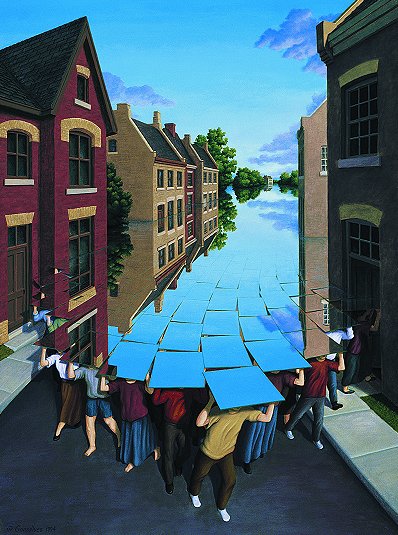
| Here Comes the Flood - Rob Gonsalves |
On Friday, I wrote a little post for Indies Unlimited that was based a creative writing professor's takedown of another creative writing professor's comments about the current crop of creative writing students.
You with me so far? Okay. To proceed, then: The author of the original article was dismayed that his students don't read much in the way of contemporary literary fiction. (Contemporary as in "written and published today," not necessarily as in "the setting of the story is the present day.") The author of the article I mentioned in my IU post said that was a rotten idea. He said basically that writers are a dime a dozen these days (and that is different from any other time in history how, exactly? But I digress...), and that creative writing programs are so successful in bringing lousy writers up to competency that it's natural for some of these barely competent writers to get published. (My response to that is that if the gatekeepers are doing their jobs, then shouldn't the barely competent be rejected in favor of the extremely competent with some regularity? But I digress again....)
Anyway, his point is that current literary fiction is banal at best, and not very good at worst -- and that writing students would be better off reading the best of any genre, not just the allegedly hoity-toity stuff.
Now that was a statement I could wrap a blog post around. And so I did. But then in that post, I made the mistake of referencing my famous rant about how magic realism is nothing but fantasy with an accent.
Karen Wyld, who is Aborigine and who writes magic realism, quite rightly took me to task for it. Her post on her own blog in defense of magic realism is here. It's terrific. You should click through and read it. But basically, she says (and I hope I don't get myself in trouble again for paraphrasing...) that magic realism grew out of the storytelling tradition, and that the genre was created by the dispossessed, or their descendants, as a way of explaining to others what they could not explain in any other way. The magic in magic realism is intended to bring the reader into the writer's world, to let the reader feel what the writer feels about his or her lost land and way of life.
She's right, of course. One need only think about books like Laura Esquivel's Like Water for Chocolate or Toni Morrison's Beloved, or anything by Gabriel Garcia Marquez, and see how the magical events in these stories are there to evoke an emotional response in the reader.
But my original point was that the best fantasy writers do the same thing. It's certainly true that a lot of them use magic simply as gee-whiz window dressing. But the really good ones use it as a device to develop the characters' personalities and to underline their flaws -- and to evoke thereby a specific emotional response in the reader. I keep going back to Stephen R. Donaldson because he's one of my favorite authors -- but he's one of my favorites because he's so damn good at this kind of thing. Terisa Morgan surrounds herself with mirrors in order to convince herself that she's real; then a magic mirror becomes her portal to adventure and allows her to conquer her fear. Thomas Covenant, stripped of everything that means anything to him, is brought to the Land, where he has unimaginable power that he never asked for and cannot bring himself to trust; he struggles to find a way to use this newfound power without betraying himself.
When I was in grad school, this frustrated me. Any fantasy novel was dismissed as crap because, you know, it had magic in it. But if a foreign author wrote a book that had magic in it, well, then, we can call it magic realism and it's okay to read -- the magic is there to explain why us white folks should feel bad about conquering these other cultures. So it's not really magic -- it's a literary device. It's allegory. Or something.
It's insulting, is what it is: insulting to writers of both magic realism and serious fantasy. Good writing is good writing, period. Why we have to shove it into little labeled boxes and turn our noses up at one while lauding another escapes me.
Anyway, to be clear: magic realism isn't just fantasy with an accent. But fantasy isn't dreck by definition, either.
***
In other news, and speaking of fantasy and Stephen R. Donaldson, I hope you saw my interview at John Pythyon's blog earlier this week. It was a ton of fun to do, and I think it turned out really well.
And you may have already heard that I sent off Annealed to my editor last night. Yay for progress!
***
This moment of bloggy clarification is brought to you, as a public service, by Lynne Cantwell.
Sunday, April 28, 2013
Thises and thats, or: allergies suck.
You'll have to forgive me if this post seems a little disjointed. I've been fighting spring allergies all week, and the allergies have been winning. My bed is awash in partly-used tissues; I would wake up coughing after a couple of hours' sleep, grab a tissue and sort of blow my nose, then fall back to sleep for a couple more hours with the tissue still in my hand. Of course, I'd lose my grip on the tissue as soon as I fell asleep, and then the tissue would get lost in the bedclothes. Lather, rinse, repeat. I can't wait to do laundry -- I'm sure I'll find five or ten more tissues betwixt sheet and blankets.
It's been quite a number of years since spring has whacked me so badly. I gather that this year's chilly weather held everything back, and then we had several days of hot weather, which encouraged all the trees to fire off their pollen sacs at once. That would have been Thursday and Friday, the 18th and 19th, which coincidentally is when my nose started running like a faucet. It's supposed to get better for the next couple of days. And we got a little rain today, which should have washed the air clean. In theory. It may be a while before my sinuses catch up with that theory.
***
So now that the first draft of Annealed is done, I thought it might be good to finish the research. Look, it's not my fault, okay? I was waiting for the magic of interlibrary loan to bring me the books I need. I'm trying to find out something about Australian Aboriginal spiritual practices because an Aboriginal makes a sort of cameo appearance in Annealed, together with practitioners of some other traditional religions around the world.
Interlibrary loan provided just one of the books I requested: Dreamkeepers by Harvey Arden. But as it happens, the book we're reading for my Pagan book group just now -- Animism: Respecting the Living World by Graham Harvey -- has a short chapter on Aboriginal culture, as well.
I expect that just about everybody knows about the Dreaming, the time out of time when the Aboriginal world was created. And a lot of people are probably aware that for Aboriginals, the Dreaming isn't a once-upon-a-time thing, but is still happening now. What I didn't realize was the extent to which Aboriginal tribes self-identified with their home regions. In North America, events like the Trail of Tears -- the forced march of the Cherokee people from the southeastern United States to Oklahoma -- were terrible and should never have happened. But some of the tribes themselves were nomads. The Sioux, for example, may have started out in the upper Midwest, and moved to the Plains after repeated conflicts with other tribes.
In Australia, I'm learning, things are different. Each Aboriginal tribe or nation had its own region, and to them, those lands are alive. Really alive. A story about a Dreaming being who fell asleep, lending a particular shape to a line of hills, isn't just a myth to explain how the hills got that shape; the hills are that shape because Dreaming being never left. So Aboriginals feel they have a responsibility to care for their tribal lands. They have stories to hand down to new generations, cave paintings and other features of the landscape to maintain, and so on. But the white settlers couldn't wrap their brains around this idea. To them, the land is just the land, a thing to exploit. So they brought the Aboriginals onto their ranches as workers, and then later (when the government decreed that ranchers treat Aboriginals like human beings) kicked them out and sent them to live in camps and shanty towns away from their native lands. So for the Aboriginals, not only can they not take care of their tribal lands properly, but they can't teach their children how to be a proper member of the tribe, either.
The books I've been reading are at least a decade old, and so I'm hopeful things have changed in the interim. Not very hopeful, mind you, but hopeful.
***
Besides learning a little bit about Aboriginals in Australia, I've also been reading -- for the first time ever -- The Eye in the Pyramid, the first book in the Illuminatus! Trilogy, by Robert Shea and Robert Anton Wilson. It was first published in 1975, the year I graduated from high school, and boy, is it ever a trip.
And I played around with Audacity yesterday and came up with a 30-second radio ad that will air on the Indie Exchange's Blog Talk Radio shows next month. I'm going to try to figure out how to upload it onto the blog so you can listen to it, if you like, and see whether I sound as bad as I've been feeling this week. If it works, it'll be on the Radio Appearances tab.
***
These moments of disjointed blogginess are brought to you, as a public service, by Lynne Cantwell.
Sunday, April 21, 2013
ANNEALED news! and: I coulda been a contender...
(This post first ran, in an ever-so-slightly edited form, at www.indiesunlimited.com this past Friday.)
Man, I was so sure I was going to win. I was so close to the
semifinal circle in the Amazon Breakthrough Novel Awards that I could taste it.
My Tarot cards even said good news was coming! What could possibly go wrong?
Well, Seized could fail
to be a semifinalist. That’s what could go wrong. And did, this past Tuesday.
If you’ve been playing this game of life for long enough, you’ve
entered some contest or another, and unless you’re an extraordinary individual
(and if so, I’d like to stand very close to you so the magic rubs off), you’ve
lost at least once. So you know what it’s like: the sinking feeling in your
gut; the denial; the rage; the desire to put the whole episode into your next novel
and savage all those rotten writers whose books made the cut, because God knows
nobody’s – NOBODY’S – was better than yours!
Oh, right. Sorry.
The rage and denial, at least, have been clinically documented. Years
ago, Elisabeth Kubler-Ross famously wrote a book about the stages of grieving,
and those two emotions are in there, along with three others. Here, then, as a
way of helping my own healing along (and with apologies to Ms. Kubler-Ross), I
offer the Five Stages of Grief for the Writing Contest Loser:
- Denial. “There must be some mistake!” For me, this was exacerbated by Amazon’s server issues on Tuesday, the day the semifinalists were announced. I couldn’t get to the page and had to rely on the Minion Brigade to check the list for me. So I had that niggling sense that maybe somebody had looked at it funny, and my book really was there, after all, and it was all a big mistake.
- Anger. See “the desire to put the whole episode in your WIP” above.
- Bargaining. This stage is marked by sacrifices to one’s deity of choice: “I’ll do anything You ask, if You’ll just make their site go down long enough for them to put up the corrected list of winners!” This is also known as the “if only” stage: “If only I’d tweaked the book a little more, or edited it one more time, or spent more time beefing up the section on X, I just know would have won.”
- Depression. Unfortunately, and particularly for writers with fragile egos, the “if only” stage can send them right into a spiral of despair of the “I’ll never be good enough” variety. Sadness is a normal, and even healthy, reaction to losing something you value. Make a date with your coping mechanism of choice (alcohol, ice cream, bubble baths, movies that make you cry) and get on with it. But if if you find yourself wallowing in grief, please go talk to somebody who can help you get over it – a friend, a family member, other writers, the dog you kicked in stage 2, or a mental health professional.*
- Acceptance. There comes a day when you find that while the world is not the place it was, all shiny and full of promise, you have the strength to go on. As for me, I said all along that I was only in the ABNA for the Quarter-finalist prize – the Publishers Weekly review (which you can read at the tab up top). And I got this blog post out of it, too. So really, by my own measure of success, I won.
Although I wouldn’t have turned down the cash.
*A lot of this post has been tongue-in-cheek, but I’m dead serious
about this. Depression is an illness caused by a chemical imbalance in the
brain, and long-standing feelings of sadness and worthlessness are among its symptoms.
If you have felt this way for a long time, please get checked out.
***
In happier news: This morning, I finished the first draft of Annealed. Whoo hoo! I think I tied up all the loose ends (although I'm sure y'all will let me know if I overlooked something...). I'm planning to let it ferment...uh, that is, ripen...for a bit, then do a first editing pass, and then send it to my editor. Still hoping for publication in mid to late May. Stay tuned....
***
This moment of rollercoaster-emotion-fueled blogginess is brought to you, as a public service, by Lynne Cantwell.
***
This moment of rollercoaster-emotion-fueled blogginess is brought to you, as a public service, by Lynne Cantwell.
Subscribe to:
Posts (Atom)

